


Page 34 - The Book of Caterpillars: A Life-Size Guide to Six Hundred Species From Around the World
P. 34
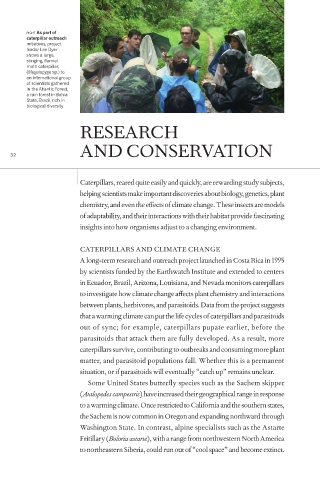
right As part of
          caterpillar outreach
          initiatives, project
          leader Lee Dyer
          shows a large,
          stinging, flannel
          moth caterpillar,
          (Megalopyge sp.) to
          an international group
          of scientists gathered
          in the Atlantic Forest,
          a rain forest in Bahia
          State, Brazil, rich in
          biological diversity.

                           RESEARCH


                           AND CONSERVATION

    32
    32


                           Caterpillars, reared quite easily and quickly, are rewarding study subjects,

                           helping scientists make important discoveries about biology, genetics, plant
                           chemistry, and even the effects of climate change. These insects are models
                           of adaptability, and their interactions with their habitat provide fascinating
                           insights into how organisms adjust to a changing environment.


                           CATERPILLARS AND CLIMATE CHANGE

                           A long-term research and outreach project launched in Costa Rica in 1995
                           by scientists funded by the Earthwatch Institute and extended to centers
                           in Ecuador, Brazil, Arizona, Louisiana, and Nevada monitors caterpillars
                           to investigate how climate change affects plant chemistry and interactions

                           between plants, herbivores, and parasitoids. Data from the project suggests
                           that a warming climate can put the life cycles of caterpillars and parasitoids
                           out of sync; for example, caterpillars pupate earlier, before the
                           parasitoids that attack them are fully developed. As a result, more
                           caterpillars survive, contributing to outbreaks and consuming more plant

                           matter, and parasitoid populations fall. Whether this is a permanent
                           situation, or if parasitoids will eventually “catch up” remains unclear.
                             Some United States butterfly species such as the Sachem skipper
                           (Atalopedes campestris) have increased their geographical range in response

                           to a warming climate. Once restricted to California and the southern states,
                           the Sachem is now common in Oregon and expanding northward through
                           Washington State. In contrast, alpine specialists such as the Astarte
                           Fritillary (Boloria astarte), with a range from northwestern North America
                           to northeastern Siberia, could run out of “cool space” and become extinct.

