


Page 29 - The Book of Caterpillars: A Life-Size Guide to Six Hundred Species From Around the World
P. 29
CATERPILLAR DEFENSES


            the caterpillar shoots out the gland, which resembles a snake tongue and

            glistens with an odiferous secretion that repels predators. Many caterpillars
            from other butterfly and moth families possess a similar eversible fleshy
            “neck” gland, located ventrally beneath the head on the anterior margin
            of the first segment. These organs (called adenosma) also contain chemicals

            that appear to repel ants and other predators.


            SAFETY IN NUMBERS
            Aggregation, or gregariousness—group feeding and resting—is
            a behavioral tactic to reduce the odds of any single individual being

            attacked; this is often practiced in
            early instars before other defense                                                    27
            methods develop. Communal
            larvae may also build silken webs,

            supports, and platforms to help
            keep the community together.
               In some caterpillars, including
            the California Tortoiseshell (Nym-
            phalis californica), the less impor-
            tant rear end strongly resembles the

            crucial head end in a bid to confuse
            predators. Early instars of this
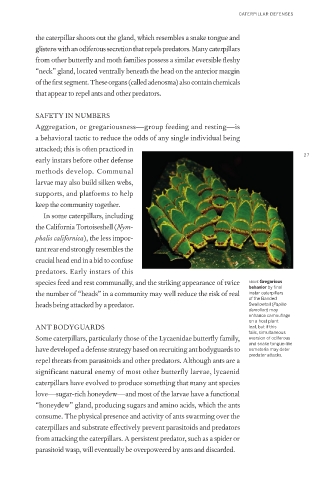
            species feed and rest communally, and the striking appearance of twice   above Gregarious
                                                                                behavior by final
            the number of “heads” in a community may well reduce the risk of real   instar caterpillars
                                                                                of the Banded
            heads being attacked by a predator.                                 Swallowtail (Papilio
                                                                                demolion) may
                                                                                enhance camouflage
                                                                                on a host plant
            ANT BODYGUARDS                                                      leaf, but if this
                                                                                fails, simultaneous
            Some caterpillars, particularly those of the Lycaenidae butterfly family,   eversion of odiferous
                                                                                and snake tongue-like
            have developed a defense strategy based on recruiting ant bodyguards to   osmeteria may deter
                                                                                predator attacks.
            repel threats from parasitoids and other predators. Although ants are a
            significant natural enemy of most other butterfly larvae, lycaenid
            caterpillars have evolved to produce something that many ant species
            love—sugar-rich honeydew—and most of the larvae have a functional

            “honeydew” gland, producing sugars and amino acids, which the ants
            consume. The physical presence and activity of ants swarming over the
            caterpillars and substrate effectively prevent parasitoids and predators
            from attacking the caterpillars. A persistent predator, such as a spider or
            parasitoid wasp, will eventually be overpowered by ants and discarded.

