


Page 31 - The Book of Caterpillars: A Life-Size Guide to Six Hundred Species From Around the World
P. 31
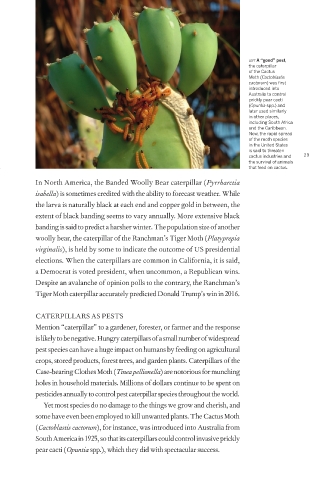
LEFT A “good” pest,
                                                                                the caterpillar
                                                                                of the Cactus
                                                                                Moth (Cactoblastis
                                                                                cactorum) was first
                                                                                introduced into
                                                                                Australia to control
                                                                                prickly pear cacti
                                                                                (Opuntia spp.) and
                                                                                later used similarly
                                                                                in other places,
                                                                                including South Africa
                                                                                and the Caribbean.
                                                                                Now, the rapid spread
                                                                                of the moth species
                                                                                in the United States
                                                                                is said to threaten
                                                                                cactus industries and   29
                                                                                the survival of animals
                                                                                that feed on cactus.
            In North America, the Banded Woolly Bear caterpillar (Pyrrharctia

            isabella) is sometimes credited with the ability to forecast weather. While
            the larva is naturally black at each end and copper gold in between, the
            extent of black banding seems to vary annually. More extensive black
            banding is said to predict a harsher winter. The population size of another
            woolly bear, the caterpillar of the Ranchman’s Tiger Moth (Platyprepia
            virginalis), is held by some to indicate the outcome of US presidential

            elections. When the caterpillars are common in California, it is said,
            a Democrat is voted president, when uncommon, a Republican wins.
            Despite an avalanche of opinion polls to the contrary, the Ranchman’s
            Tiger Moth caterpillar accurately predicted Donald Trump’s win in 2016.


            CATERPILLARS AS PESTS
            Mention “caterpillar” to a gardener, forester, or farmer and the response
            is likely to be negative. Hungry caterpillars of a small number of widespread
            pest species can have a huge impact on humans by feeding on agricultural

            crops, stored products, forest trees, and garden plants. Caterpillars of the
            Case-bearing Clothes Moth (Tinea pellionella) are notorious for munching
            holes in household materials. Millions of dollars continue to be spent on
            pesticides annually to control pest caterpillar species throughout the world.

               Yet most species do no damage to the things we grow and cherish, and
            some have even been employed to kill unwanted plants. The Cactus Moth
            (Cactoblastis cactorum), for instance, was introduced into Australia from
            South America in 1925, so that its caterpillars could control invasive prickly
            pear cacti (Opuntia spp.), which they did with spectacular success.

