


Page 32 - The Book of Caterpillars: A Life-Size Guide to Six Hundred Species From Around the World
P. 32
CATERPILLARS AND PEOPLE


    30
    30

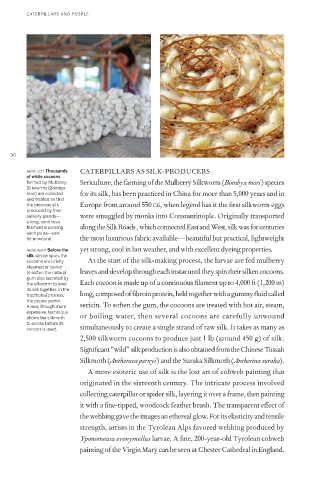
          above left Thousands   CATERPILLARS AS SILK-PRODUCERS
          of white cocoons
          formed by Mulberry   Sericulture, the farming of the Mulberry Silkworm (Bombyx mori) species
          Silkworms (Bombyx
          mori) are collected   for its silk, has been practiced in China for more than 5,000 years and in
          and treated so that
          the precious silk   Europe from around 550 ce, when legend has it the first silkworm eggs
          produced by their
          salivary glands—   were smuggled by monks into Constantinople. Originally transported
          a long, continous
          filament enclosing   along the Silk Roads , which connected East and West, silk was for centuries
          each pupa—can
          be unwound.      the most luxurious fabric available—beautiful but practical, lightweight
          above right Before the   yet strong, cool in hot weather, and with excellent dyeing properties.
          silk can be spun, the
          cocoons are briefly   At the start of the silk-making process, the larvae are fed mulberry
          steamed or boiled
          to soften the natural   leaves and develop through each instar until they spin their silken cocoons.
          gum also secreted by
          the silkworm to bind   Each cocoon is made up of a continuous filament up to 4,000 ft (1,200 m)
          its silk together. In the   long, composed of fibroin protein, held together with a gummy fluid called
          traditional process,
          the pupae perish.    sericin. To soften the gum, the cocoons are treated with hot air, steam,
          A new, though more
          expensive, technique   or boiling water, then several cocoons are carefully unwound
          allows the silkmoth
          to eclose before its   simultaneously to create a single strand of raw silk. It takes as many as
          cocoon is used.
                           2,500 silkworm cocoons to produce just 1 lb (around 450 g) of silk.
                           Significant “wild” silk production is also obtained from the Chinese Tussah

                           Silkmoth (Antheraea pernyi) and the Suraka Silkmoth (Antherina suraka).
                             A more esoteric use of silk is the lost art of cobweb painting that
                           originated in the sixteenth century. The intricate process involved
                           collecting caterpillar or spider silk, layering it over a frame, then painting

                           it with a fine-tipped, woodcock feather brush. The transparent effect of
                           the webbing gave the images an ethereal glow. For its elasticity and tensile
                           strength, artists in the Tyrolean Alps favored webbing produced by
                           Yponomeuta evonymellus larvae. A fine, 200-year-old Tyrolean cobweb
                           painting of the Virgin Mary can be seen at Chester Cathedral in England.

