


Page 30 - The Book of Caterpillars: A Life-Size Guide to Six Hundred Species From Around the World
P. 30
CATERPILLARS


                           AND PEOPLE

    28
    28


                           Butterflies are celebrated in literature and art, and moths make an occasional

                           sinister appearance, but their larvae feature more rarely and play quite
                           singular and disparate roles in popular culture. Some species are still best
                           known as destructive pests, but the caterpillar has important uses, too, as
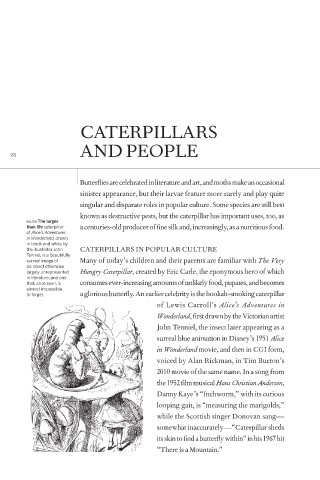
          BELOW The larger
          than life caterpillar   a centuries-old producer of fine silk and, increasingly, as a nutritious food.
          of Alice’s Adventures
          in Wonderland, drawn
          in black and white by
          the illustrator John   CATERPILLARS IN POPULAR CULTURE
          Tenniel, is a beautifully
          surreal image of   Many of today’s children and their parents are familiar with The Very
          an insect otherwise
          largely unrepresented   Hungry Caterpillar, created by Eric Carle, the eponymous hero of which
          in literature, and one
          that, once seen, is   consumes ever-increasing amounts of unlikely food, pupates, and becomes
          almost impossible
          to forget.       a glorious butterfly. An earlier celebrity is the hookah-smoking caterpillar
                                                   of Lewis Carroll’s Alice’s Adventures in
                                                   Wonderland, first drawn by the Victorian artist
                                                   John Tenniel, the insect later appearing as a
                                                   surreal blue animation in Disney’s 1951 Alice
                                                   in Wonderland movie, and then in CGI form,

                                                   voiced by Alan Rickman, in Tim Burton’s
                                                   2010 movie of the same name. In a song from
                                                   the 1952 film musical Hans Christian Andersen,
                                                   Danny Kaye’s “Inchworm,” with its curious

                                                   looping gait, is “measuring the marigolds,”
                                                   while the Scottish singer Donovan sang—
                                                   somewhat inaccurately—“Caterpillar sheds
                                                   its skin to find a butterfly within” in his 1967 hit
                                                   “There is a Mountain.”

