


Page 634 - The Book of Caterpillars: A Life-Size Guide to Six Hundred Species From Around the World
P. 634
MOTH CATERPILLARS

                                                     FAMILY  Noctuidae
                                                 DISTRIBUTION  Eastern North America, from Ontario to Florida,
                                                          west to Montana and Texas
                                                    HABITAT  Woodlands and forest edges
                                                  HOST PLANTS  Greenbrier (Smilax spp.)
                                                      NOTE  Caterpillar that has been described as “fantastically bizarre”
                                             CONSERVATION STATUS  Not evaluated, but sometimes common


            ADULT WINGSPAN


           1⅛–1⅜ in (28–35 mm)
           CATERPILLAR LENGTH

           1 ⁄  –1⅜ in (30–35 mm)

                                                                  PHYPROSOPUS CALLITRICHOIDES
                                             CURVE-LINED OWLET MOTH
    632
                                                                                     GROTE, 1872

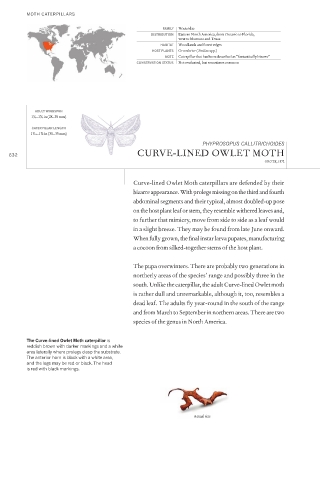
                                            Curve-lined Owlet Moth caterpillars are defended by their
                                            bizarre appearance. With prolegs missing on the third and fourth
                                            abdominal segments and their typical, almost doubled-up pose
                                            on the host plant leaf or stem, they resemble withered leaves and,
                                            to further that mimicry, move from side to side as a leaf would
                                            in a slight breeze. They may be found from late June onward.
                                            When fully grown, the  nal instar larva pupates, manufacturing

                                            a cocoon from silked-together stems of the host plant.


                                            The pupa overwinters. There are probably two generations in
                                            northerly areas of the species’ range and possibly three in the
                                            south. Unlike the caterpillar, the adult Curve-lined Owlet moth
                                            is rather dull and unremarkable, although it, too, resembles a

                                            dead leaf. The adults  y year-round in the south of the range
                                            and from March to September in northern areas. There are two
                                            species of the genus in North America.


          The Curve-lined Owlet Moth caterpillar is
          reddish brown with darker markings and a white
          area laterally where prolegs clasp the substrate.
          The anterior horn is black with a white area,
          and the legs may be red or black. The head
          is red with black markings.


                                                               Actual size

