


Page 635 - The Book of Caterpillars: A Life-Size Guide to Six Hundred Species From Around the World
P. 635
MOTH CATERPILLARS

                      FAMILY  Noctuidae
                  DISTRIBUTION  From Spain and the British Isles across Europe, including the
                           Mediterranean and southern half of Scandinavia; Asia Minor,
                           the Caucasus, southern Siberia, and east to Russian Far East and
                           Japan; across western and southern central Asia to eastern China
                     HABITAT  Calcareous grasslands, moorlands, open woodlands, low-lying
                           damp grasslands, coastal sand dunes, and shingle; also urban
                           habitats, including gardens
                  HOST PLANTS  Many, including rest-harrow (Ononis spp.), sainfoin (Onobrychis
                           spp.), Henbane (Hyoscyamus niger), and Sea Sandwort
                           (Honkenya peploides)

                      NOTE  Variably colored caterpillar that feeds on  owers and unripe seeds
             CONSERVATION STATUS  Not evaluated, but widespread


                                                                                   ADULT WINGSPAN
                                                                                  1 ⁄  –1⅝ in (33–41 mm)
                                                                                  CATERPILLAR LENGTH
                                                                                  1 ⁄  –1 ⁄   in (33–37 mm)
            PYRRHIA UMBRA
            BORDERED SALLOW                                                                      633

            (HUFNAGEL, 1766)


            The Bordered Sallow caterpillar hatches from a ribbed, whitish
            egg laid on a leaf or  ower. It feeds openly on the  owers and


            immature seeds of its food plant, thereby picking up di erent

            pigments from the wide variety of host plants favored. This
            probably explains the great variability of color in this species.
            When fully fed, the caterpillar forms a pupa in the ground,
            which overwinters. There is usually a single generation in
            the late summer and early fall; in warmer conditions, a partial
            second generation may occur.


            The adult ecloses between May and September and is similar
            in appearance to the closely related Pyrrhia exprimens, whose
            caterpillar is, however, more boldly marked than the Bordered
            Sallow. The range of P. umbra—the most extensive of its
            genus—was once thought to include North America. However,
            in 1996, the United States lookalike was described as a new
            species, P. adela, but is still commonly known as the Bordered
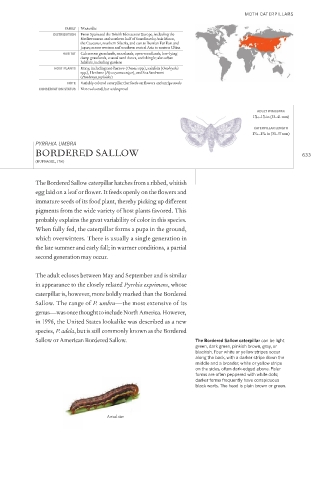
            Sallow or American Bordered Sallow.                The Bordered Sallow caterpillar can be light
                                                               green, dark green, pinkish brown, gray, or
                                                               blackish. Four white or yellow stripes occur
                                                               along the back, with a darker stripe down the
                                                               middle and a broader, white or yellow stripe
                                                               on the sides, often dark-edged above. Paler
                                                               forms are often peppered with white dots;
                                                               darker forms frequently have conspicuous
                                                               black warts. The head is plain brown or green.


                                   Actual size

