


Page 71 - The Book of Caterpillars: A Life-Size Guide to Six Hundred Species From Around the World
P. 71
BUTTERFLY CATERPILLARS

                      FAMILY  Hesperiidae
                  DISTRIBUTION  Occasionally Texas; Mexico, south to Costa Rica and Panama,
                           and east to the Greater Antilles; South America, south to
                           Bolivia and southern Brazil
                     HABITAT  Most tropical areas below 3,300 ft (1,000 m) elevation
                  HOST PLANTS  Pea family (Fabaceae), particularly coral trees (Erythrina spp.)
                      NOTE  Caterpillar that is an accomplished excrement thrower and
                           tent builder
             CONSERVATION STATUS  Not evaluated, but common and unlikely to become endangered


                                                                                   ADULT WINGSPAN
                                                                                  2⅛–2⁹∕₁₆ in (55–65 mm)
                                                                                  CATERPILLAR LENGTH
                                                                                  1½–1¾ in (38–44 mm)
            ASTRAPTES ALARDUS
            FROSTED FLASHER                                                                       69

            (STOLL, 1790)


            The caterpillars of the widespread Frosted Flasher are
            predictably found anywhere within their range that Erythrina
            plants occur. Their distinctive, peaked tents, pyramidal in
            shape and folded to the upper surface of the leaf along a narrow
            strip of leaf, are easily spotted, even from a distance. When the

            caterpillars have developed to the fourth or fifth instar, they
            build a pocket-like shelter between two leaves, where they later
            pupate. The caterpillars are skillful frass-throwers, with mature

            larvae able to fling frass more than 3 ft (1 m).

            Males perch in patches of sunlight, lying in wait for females.
            When not searching for oviposition sites or guarding perches,
            adults tend to rest upside down under large leaves, with their
            wings closed. Frosted Flashers are probably among those species
            slowly increasing their range, due largely to their use of coral
            trees as host plants. The trees are commonly planted in large
            numbers in both agricultural and populated areas, facilitating
            invasion by this species.


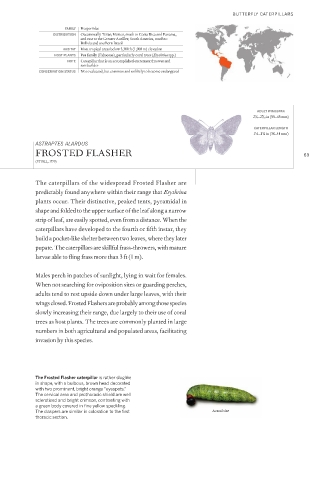
            The Frosted Flasher caterpillar is rather sluglike
            in shape, with a bulbous, brown head decorated
            with two prominent, bright orange “eyespots.”
            The cervical area and prothoracic shield are well
            sclerotized and bright crimson, contrasting with
            a green body covered in   ne yellow speckling.
            The claspers are similar in coloration to the   rst      Actual size
            thoracic section.

