


Page 75 - The Book of Caterpillars: A Life-Size Guide to Six Hundred Species From Around the World
P. 75
BUTTERFLY CATERPILLARS
FAMILY Hesperiidae
DISTRIBUTION Tropical Mexico to French Guiana and south along the Andes to
Colombia, and probably at least northern Ecuador
HABITAT Humid montane forest borders and second growth
HOST PLANTS Achyranthes spp.
NOTE Caterpillar whose early instars construct distinctive,
manhole-cover-like shelters
CONSERVATION STATUS Not evaluated, but not considered threatened
ADULT WINGSPAN
1⅛–1⁄ in (28–34 mm)
CATERPILLAR LENGTH
1⅛–1¼ in (28–32 mm)
BOLLA GISELUS
BOLLA GISELUS 73
(MABILLE, 1883)
Bolla giselus caterpillars hatch from tiny, brown eggs laid singly,
usually on the underside of young host plant leaves. After
consuming most of their eggshell, they excise a roughly oval-
shaped flap from the center of the leaf, flipping this lid over onto
the upper or the lower surface of the leaf. The young larvae
rest within this shelter and throw their frass considerable
distances with the aid of an anal comb. Feeding damage around
these shelters is distinctive, as young larvae eat only one side
of the leaf, leaving clear, window-like perforations.
Older larvae tend to sew two entire leaves together, resting
within this pocket when not feeding. Copious silk laid within
the shelter can cause it to bow strongly outward, giving the
caterpillar more room to maneuver within. Pupation occurs
within the last larval shelter. Adults are fast fl iers, feeding at
many of the common roadside flowers, pausing frequently to
bask in the sun with their wings spread.
Actual size
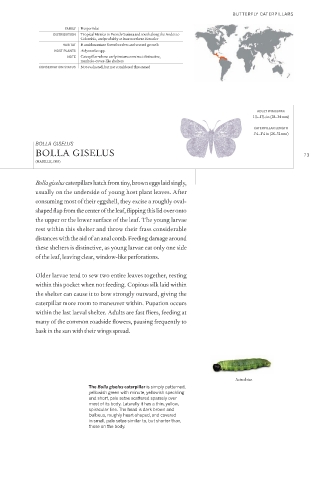
The Bolla giselus caterpillar is simply patterned,
yellowish green with minute, yellowish speckling
and short, pale setae scattered sparsely over
most of its body. Laterally it has a thin, yellow,
spiracular line. The head is dark brown and
bulbous, roughly heart-shaped, and covered
in small, pale setae similar to, but shorter than,
those on the body.

