


Page 73 - The Book of Caterpillars: A Life-Size Guide to Six Hundred Species From Around the World
P. 73
BUTTERFLY CATERPILLARS
FAMILY Hesperiidae
TRIBUTION
DISTRIBUTION Southwestern United States, northern Mexico
DISTRIBUTION
DIS
HABITAT
A
HABITAT T Arid canyons and washes
HABIT
HOST PLANTS S Bouteloua curtipendula var. caespitosa
T PLANT
HOST PLANTS
HOS
NOTE
TE
NOTE Caterpillar that builds aerial nests in one native grass species
NO
TUS
A
A
T
TION S
CONSERVATION STATUS
CONSERV
CONSERVATION STATUS Not evaluated, and apparently secure, but possibly quite rare
at the periphery of its range
ADULT WINGSPAN
1¼–1⅝ in (32–42 mm)
CATERPILLAR LENGTH
1³∕₁₆ in (30 mm)
ATRYTONOPSIS VIERECKI
VIERECK’S SKIPPER 71
(SKINNER, 1902)
The Viereck’s Skipper caterpillar lives in a tube formed of leaves
it joins together with silk produced by a spinneret beneath its
head. The larvae eat only the caespitosa variety of Bouteloua
curtipendula as it is leafier than the main species and its large
clumps provide more cover for their nests. The caterpillars grow
to mature size by late summer, then hibernate in silked-leaf nests
at the base of the grass clump. In spring they pupate, and adults
emerge a week or two later, in May.
Tiny Trichogrammatidae wasps, which have a wingspan
of only / in (1 mm), lay an egg in many of the Atrytonopsis
vierecki eggs. The wasp larva eats the contents of the egg and
then produces a wasp instead of a caterpillar. Parasitic wasps
attack the eggs of most butterfly and moth species. The desert
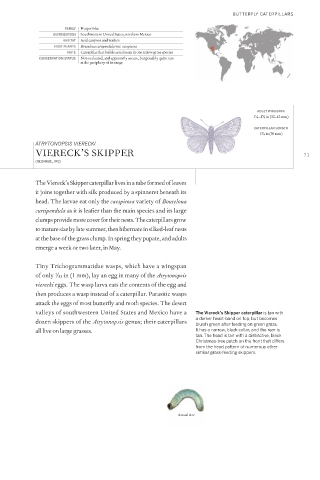
valleys of southwestern United States and Mexico have a The Viereck’s Skipper caterpillar is tan with
dozen skippers of the Atrytonopsis genus; their caterpillars a darker heart-band on top, but becomes
bluish green after feeding on green grass.
all live on large grasses. It has a narrow, black collar, and the rear is
tan. The head is tan with a distinctive, black
Christmas-tree patch on the front that di ers
from the head pattern of numerous other
similar grass-feeding skippers.
Actual size

