


Page 74 - The Book of Caterpillars: A Life-Size Guide to Six Hundred Species From Around the World
P. 74
BUTTERFLY CATERPILLARS
FAMILY Hesperiidae
DISTRIBUTION India, China, Southeast Asia, the Philippines, Indonesia,
Papua New Guinea, Australia, and Fiji
HABITAT Openings and edges of deciduous and evergreen tropical forests
HOST PLANTS Terminalia spp., Pongamia spp., Rhyssopterys spp.,
and Combretum spp.
NOTE Caterpillar that may defoliate food plant, compelling adults
to migrate
CONSERVATION STATUS Not evaluated, but widespread and common
ADULT WINGSPAN
1⅞–2⁄ in (48–52 mm)
CATERPILLAR LENGTH
1¾ in (45 mm)
BADAMIA EXCLAMATIONIS
BROWN AWL
72
(FABRICIUS, 1775)
The Brown Awl caterpillar, also known as the Narrow-winged
Awl, forms an open shelter on young foliage by joining the edges
of leaves together with silk. Feeding outside the shelter occurs
during the day and night. The caterpillar grows fast and has
moist, sticky frass. When about to pupate, the caterpillar may
descend close to the ground, particularly if the plant has been
defoliated, and construct a tubular cell from a leaf. The cell is
heavily lined with silk, and the pupa is attached to the silken
pad by the cremaster and a silk girdle. There may be several
generations a year.
Populations of this insect can be very large, and the caterpillars
can strip their food supply, forcing migration of the adults.
Migrations may extend beyond the species’ normal breeding
areas, but, where fresh food is located, a return migration may
also occur. The adults have a rapid audible flight.
Actual size
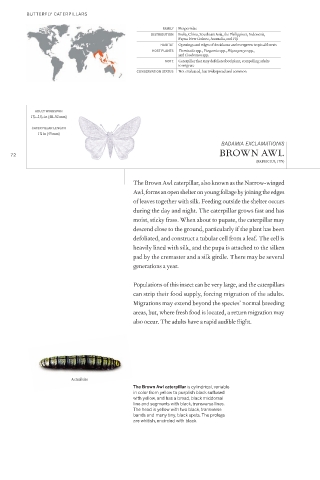
The Brown Awl caterpillar is cylindrical, variable
in color from yellow to purplish black su used
with yellow, and has a broad, black middorsal
line and segments with black, transverse lines.
The head is yellow with two black, transverse
bands and many tiny, black spots. The prolegs
are whitish, encircled with black.

