


Page 67 - The Book of Caterpillars: A Life-Size Guide to Six Hundred Species From Around the World
P. 67
BUTTERFLY CATERPILLARS
FAMILY Papilionidae
DISTRIBUTION The Balkans, the Middle East
HABITAT Dry grassland and meadows up to 3,300 ft (1,000 m) elevation
in disturbed areas
HOST PLANTS Birthwort (Aristolochia spp.)
NOTE Distinctive spiky caterpillar that has black, white, and red markings
CONSERVATION STATUS Not evaluated
ADULT WINGSPAN
2⁄– 2⁄ in (52–62 mm)
CATERPILLAR LENGTH
1⁄–1⅜ in (30–35 mm)
ZERYNTHIA CERISY
EASTERN FESTOON 65
(GODART, [1824])
Eastern Festoon caterpillars hatch from creamy yellow eggs
laid singly or in small groups by the female butterfly on the
underside of leaves of the host plant, generally in shade. The
larvae feed on the leaves and pupate at the base of the plant or
in stones and crevices, protected within a silken web. The species
overwinters as a pupa.
There is a single generation each year, and the butterfl ies are
seen on the wing from March to July—those at higher elevations
are the later flyers. In some parts of its range, the species is
declining due to loss of habitat, often as a result of agricultural
intensification and the use of herbicides. There are a number
of subspecies found on Mediterranean islands, including Crete.
The adult Cretan Eastern Festoon is less red in color and lacks
a tail on its wings—different enough for some to class it as a
subspecies or even a separate species (Zerynthia cretica).
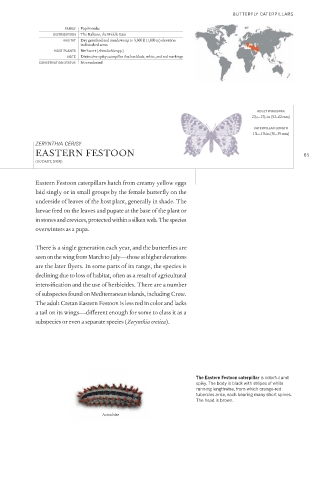
The Eastern Festoon caterpillar is colorful and
spiky. The body is black with stripes of white
running lengthwise, from which orange-red
tubercles arise, each bearing many short spines.
The head is brown.
Actual size

