


Page 68 - The Book of Caterpillars: A Life-Size Guide to Six Hundred Species From Around the World
P. 68
BUTTERFLY CATERPILLARS

                                                     FAMILY  Hesperiidae
                                                 DISTRIBUTION  From Mexico south through Central America and most of the
                                                          Caribbean; South America, south to northern Argentina
                                                    HABITAT  Lowland humid forests, forest edges, and adjacent second growth,
                                                          and gardens around human dwellings
                                                  HOST PLANTS  Various species of cultivated and wild Citrus spp., and species
                                                          of the closely related genus Zanthoxylum
                                                      NOTE  Striped caterpillar often seen feeding on Citrus trees in gardens
                                             CONSERVATION STATUS  Not evaluated, but unlikely to become endangered


            ADULT WINGSPAN
           2–2⅜ in (50–60 mm)
           CATERPILLAR LENGTH
           1⁵∕₁₆–1½ in (33–38 mm)
                                                                           ACHLYODES BUSIRUS
                                                           GIANT SICKLEWING
    66
                                                                                    (CRAMER, 1779)


                                            Like most skippers, the caterpillars of Giant Sicklewings build
                                            leaf shelters and use an anal comb to forcibly expel frass from
                                            their anus and away from their shelters. Early shelters are made
                                            with a triangular flap excised from the edge of a leaf, while
                                            the larger caterpillars pull the surfaces of two adjacent leaves
                                            together to form a pocket. Newly hatched caterpillars do not
                                            leave their shelters, but instead feed on the surface of the leaf
                                            inside their shelter, leaving the dorsal leaf cuticle intact to create
                                            small “windows.” The caterpillars pupate inside their last larval
                                            shelter, and the dark brown chrysalis is covered with a fine,
                                            white, waxy powder.


                                            The scientific species name is a reference to King Busiris,
                                            a figure from Greek and Egyptian mythology, who was,
                                            by some accounts, slain by Heracles shortly after he escaped


                                            bondage in the king’s dungeon. Adult butterflies are fast fliers
                                            and very wary as they land, with wings spread on the ground,
                                            probing the soil for minerals.


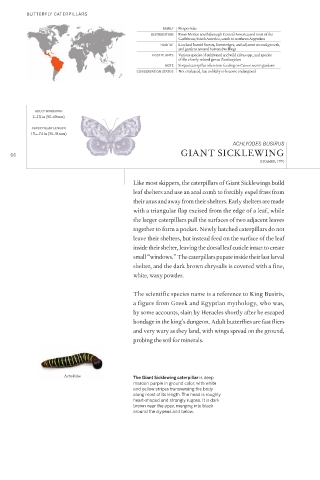
                     Actual size            The Giant Sicklewing caterpillar is deep
                                            maroon purple in ground color, with white
                                            and yellow stripes transversing the body
                                            along most of its length. The head is roughly
                                            heart-shaped and strongly rugose. It is dark
                                            brown near the apex, merging into black
                                            around the clypeus and below.

