


Page 66 - The Book of Caterpillars: A Life-Size Guide to Six Hundred Species From Around the World
P. 66
BUTTERFLY CATERPILLARS

                                                     FAMILY  Papilionidae
                                                 DISTRIBUTION  Western North America, from Alaska to New Mexico
                                                    HABITAT  Mountains, upper elevations to highest Arctic-alpine
                                                  HOST PLANTS  Stonecrop (Sedum spp.)
                                                      NOTE  Aposematic caterpillar that emits a foul odor when disturbed
                                             CONSERVATION STATUS  Not evaluated, but common within its range


            ADULT WINGSPAN
           2⅜–2⁹∕₁₆ in (60–65 mm)
           CATERPILLAR LENGTH
             1³∕₁₆ in (30 mm)
                                                                        PARNASSIUS SMINTHEUS
                                                    MOUNTAIN PARNASSIAN
    64
                                                                                  DOUBLEDAY, [1847]


                                            Mountain Parnassian females lay their eggs singly on and around
                                            stonecrop plants. The eggs overwinter and the caterpillars
                                            hatch in late spring but do not consume their eggshells. The
                                            caterpillars, which are solitary, bask openly in sunshine but feed
                                            nocturnally, primarily on leaf tips. No nests are made. The larvae
                                            are easily found by searching patches of Sedum in mountainous
                                            areas. When disturbed, the caterpillars twitch violently, drop to
                                            the ground seeking cover, and may emit a bad-smelling chemical
                                            from their yellow osmeterium. Their aposematic coloration also
                                            suggests they may be toxic.


                                            Caterpillar development is slow, taking 10 to 12 weeks. There are

                                            five instars, and pupation occurs in a loose cocoon constructed
                                            among ground debris. The flight period of the adult—a mostly

                                            white butterfly with some red spots and dark markings—is late

                                            May to early September depending on latitude and elevation.
                                            Other Parnassius species occur in North America and Eurasia,
                                            all confined to mountainous habitats.


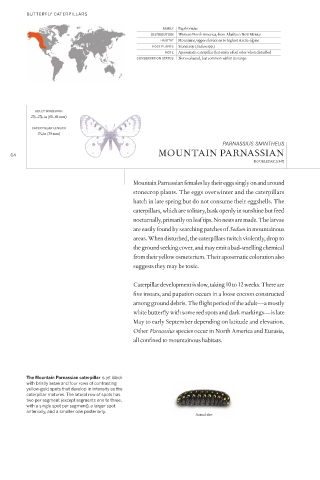
         The Mountain Parnassian caterpillar is jet black
         with bristly setae and four rows of contrasting
         yellow-gold spots that develop in intensity as the
         caterpillar matures. The lateral row of spots has
         two per segment (except segments one to three,
         with a single spot per segment), a larger spot
         anteriorly, and a smaller one posteriorly.
                                                               Actual size

