


Page 77 - The Book of Caterpillars: A Life-Size Guide to Six Hundred Species From Around the World
P. 77
BUTTERFLY CATERPILLARS
FAMILY Hesperiidae
DISTRIBUTION Northern South America (Suriname and the Guianas),
south through Amazonia to Peru and Bolivia
HABITAT Primary lowland and foothill forests up to about
2,625 ft (800 m) elevation
HOST PLANTS Unknown species of understory sapling
NOTE Caterpillar that expertly propels frass away from its leaf shelters
CONSERVATION STATUS Not evaluated
ADULT WINGSPAN
1⅜–1⁄ in (35–40 mm)
CATERPILLAR LENGTH
1⁄–1⅞ in (43–48 mm)
CABIRUS PROCAS
CABIRUS PROCAS 75
(CRAMER, 1777)
The sluglike caterpillar of Cabirus procas builds a wonderfully
intricate shelter on the leaves of its host plant, resting inside
while not feeding. A roughly square flap is excised from the
leaf margin and folded over onto the upper surface of the leaf.
A heavy layer of silk is laid down in concentric circles, on both
the upper and lower inner surfaces of the shelter, causing it to
bow outward. When threatened, the caterpillar will often rapidly
rattle its head against the shelter lid.
While resting within their leaf shelter, larvae periodically extend
their abdomen out from under the lid and expertly fire a fecal
pellet away from their home. Larger caterpillars can propel frass
more than 3 ft (1 m). For a skipper, the adult Cabirus procas is a
fairly weak flier, usually perching on the underside of leaves,
wings open. Though strikingly different in coloration, both
sexes appear to be mimics of day-flying moths.
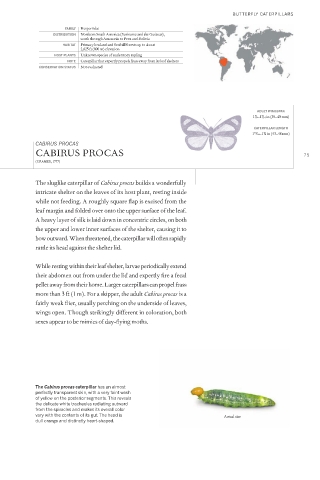
The Cabirus procas caterpillar has an almost
perfectly transparent skin, with a very faint wash
of yellow on the posterior segments. This reveals
the delicate white tracheoles radiating outward
from the spiracles and makes its overall color
vary with the contents of its gut. The head is Actual size
dull orange and distinctly heart-shaped.

