Page 78 - The Book of Caterpillars: A Life-Size Guide to Six Hundred Species From Around the World
P. 78
BUTTERFLY CATERPILLARS

                                                     FAMILY  Hesperiidae
                                                                       ough most of
                                                                  d States
                                                                     ,
                                                                       thr
                                                             r
                                                          Southe
                                                          Southern United States, through most of the Caribbean and
                                                                                  bbean and
                                                              n Unite
                                                                               the Cari
                                                 DIS
                                                   TRIBUTION
                                                 DISTRIBUTION  Southern United States, through most of the Caribbean and
                                                 DISTRIBUTION
                                                          Central America, south to Argentina
                                                          Centr al Ameri ca, sout h to Arg entin a
                                                          Central America, south to Argentina
                                                             spread, o
                                                           ide
                                                                             tivated a
                                                                                 reas
                                                                        d and cul
                                                                 ften in disturbe
                                                          W
                                                          Widespread, often in disturbed and cultivated areas, in humid,
                                                                                   , in
                                                                                      humid,
                                                    HABITAT T  Widespread, often in disturbed and cultivated areas, in humid,
                                                    HABIT
                                                       A
                                                    HABITAT
                                                          semi-humid, and strongly seasonal habitats
                                                          semi-humid, and strongly seasonal habitats
                                                          semi -humid, a nd str on gly seas on al habi tats
                                                                  ostly or
                                                             taceae, m
                                                          Mar
                                                          Marantaceae, mostly ornamental
                                                                     n
                                                                      amental
                                                            an
                                                  HOS
                                                  HOST PLANTS
                                                    T PLANT
                                                  HOST PLANTS S  Marantaceae, mostly ornamental Canna spp.; also Calathea spp.,
                                                          Maranta spp., and Thallia spp.
                                                           ar
                                                             a
                                                             nt
                                                            a

                                                                , and
                                                                .
                                                              spp
                                                          M
                                                          Maranta spp., and
                                                          Common caterpillar that in large numbers can severely
                                                          Common caterpillar that in large numbers can severely
                                                      NOTE
                                                      NOTE
                                                      NO TE  Comm on cater pillar th at in l arg e number s can  s ev erely
                                                          damage ornamentals
                                                          damag e  or n ament als
                                                          damage ornamentals
                                                                                  ed
                                                                                 er
                                                                      ely t
                                                                         o become
                                                                              endang
                                                                  but not lik
                                                             valuated,
                                                          Not e
                                                          Not evaluated, but not likely to become endangered
                                             CONSERVATION STATUS
                                             CONSERVATION STATUS
                                             CONSERV A TION S T A TUS  Not evaluated, but not likely to become endangered
            ADULT WINGSPAN
           2–2⅛ in (50–55 mm)
           CATERPILLAR LENGTH
           1½–1¾ in (38–45 mm)
                                                                            CALPODES ETHLIUS
                                                           BRAZILIAN SKIPPER
    76
                                                                                     (STOLL, 1782)
                                            Brazilian Skipper caterpillars hatch from eggs laid either singly
                                            or in small rows of two to six eggs; they are, however, heavily
                                            parasitized by tiny wasps. The young caterpillars make simple
                                            shelters by rolling a small portion of the leaf margin, often with
                                            a notch cut at each end of the roll to facilitate bending of the leaf.
                                            Feeding from one end of the shelter usually results in a triangular
                                            flap, folded either to the top or bottom of the leaf. Pupation

                                            occurs in the final larval shelter.
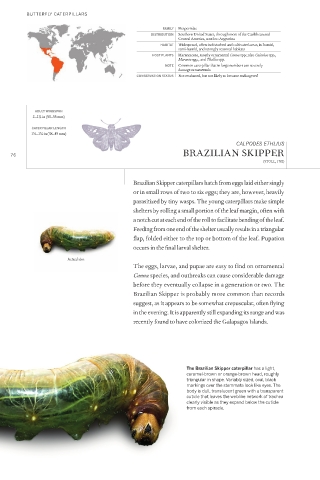
                       Actual size
                                            The eggs, larvae, and pupae are easy to find on ornamental
                                            Canna species, and outbreaks can cause considerable damage
                                            before they eventually collapse in a generation or two. The
                                            Brazilian Skipper is probably more common than records

                                            suggest, as it appears to be somewhat crepuscular, often flying
                                            in the evening. It is apparently still expanding its range and was
                                            recently found to have colonized the Galapagos Islands.
                                                             The Brazilian Skipper caterpillar has a light,
                                                             caramel-brown or orange-brown head, roughly
                                                             triangular in shape. Variably sized, oval, black
                                                             markings over the stemmata look like eyes. The
                                                             body is dull, translucent green with a transparent
                                                             cuticle that leaves the weblike network of trachea
                                                             clearly visible as they expand below the cuticle
                                                             from each spiracle.
   73   74   75   76   77   78   79   80   81   82   83