


Page 79 - The Book of Caterpillars: A Life-Size Guide to Six Hundred Species From Around the World
P. 79
BUTTERFLY CATERPILLARS
FAMILY Hesperiidae
DISTRIBUTION North Africa; southern, central, and eastern Europe to the
Caucasus and Armenia
HABITAT Juniper-oak woodlands, steppes, and dry grassy slopes
HOST PLANTS Perennial Yellow Woundwort (Stachys recta)
and Sideritis scordioides
NOTE Hairy caterpillar that feeds on developing seeds
CONSERVATION STATUS Not evaluated, but classed as near threatened in Europe
ADULT WINGSPAN
1⅛–1⁄ in (28–34 mm)
CATERPILLAR LENGTH
Up to ¾ in (20 mm)
CARCHARODUS LAVATHERAE
MARBLED SKIPPER 77
(ESPER, 1783)
The female Marbled Skipper lays her eggs, singly, on fading
flower spikes of the host plant. The young caterpillars feed on
the developing seeds found with the withered flowers, spinning
a loose web around the sepals. At about the third instar, they
overwinter as larvae and complete their growth in late spring.
The caterpillars then move to the ground, where they pupate,
commonly in the leaf litter.
There is usually one generation a year, although occasionally Actual size
two have been reported in areas of Italy and northern Greece.
The adults, the most brightly colored of their genus, are on the
wing from May to August, depending on the region, and are
found at altitudes of 650–5,250 ft (200–1,600 m). The declining
population reported in some areas is due mainly to the loss
of habitat. The species has a narrow range of host plants,
and their disappearance results in fragmentation of the
butterfly population.
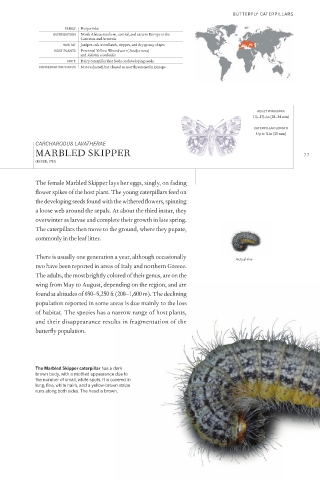
The Marbled Skipper caterpillar has a dark
brown body, with a mottled appearance due to
the number of small, white spots. It is covered in
long, ne, white hairs, and a yellow-brown stripe
runs along both sides. The head is brown.

