


Page 17 - (DK) Eyewitness - Mars
P. 17
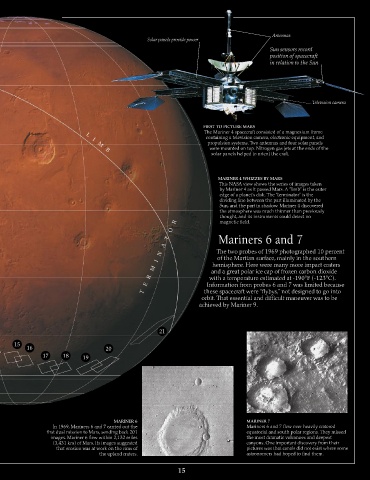
Antennas
                                                  Solar panels provide power
                                                                                          Sun sensors record
                                                                                          position of spacecraft
                                                                                          in relation to the Sun


                                                                                                        Television camera


                                                                    FIRST TO PICTURE MARS
                                                                     The Mariner 4 spacecraft consisted of a magnesium frame
                             L
                                I                                    containing a television camera, electronic equipment, and
                                                                      propulsion systems. Two antennas and four solar panels
                                 M
                                                                      were mounted on top. Nitrogen gas jets at the ends of the
                                    B
                                                                       solar panels helped to orient the craft.
                                                                         MARINER 4 WHIZZES BY MARS
                                                                         This NASA view shows the series of images taken
                                                                          by Mariner 4 as it passed Mars. A “limb” is the outer
                                                                          edge of a planet’s disk. The “terminator” is the
                                                                          dividing line between the part illuminated by the
                                                                          Sun, and the part in shadow. Mariner 4 discovered
                                                                          the atmosphere was much thinner than previously
                                                                          thought, and its instruments could detect no
                                                           R              magnetic field.
                                                          O
                                                         T               Mariners 6 and 7
                                                       A
                                                      N                  The two probes of 1969 photographed 10 percent
                                                                         of the Martian surface, mainly in the southern
                                                     I                 hemisphere. Here were many more impact craters
                                                    M                  and a great polar ice cap of frozen carbon dioxide
                                                   R                  with a temperature estimated at -190°F (-123°C).
                                                 E                   Information from probes 6 and 7 was limited because
                                                T                   these spacecraft were “flybys,” not designed to go into
                                                                    orbit. That essential and difficult maneuver was to be
                                                                   achieved by Mariner 9.


                                                     l
                                                      21
      15
         l
     l 16                          l
                                    20
              l l           l
               17
                      18
                            19


                                       MARINER                                     MARINER
                  In 1969, Mariners 6 and 7 carried out the                        Mariners 6 and 7 flew over heavily cratered
                first dual mission to Mars, sending back 201                       equatorial and south polar regions. They missed
                  images. Mariner 6 flew within 2,132 miles                        the most dramatic volcanoes and deepest
                   (3,431 km) of Mars. Its images suggested                        canyons. One important discovery from their
                    that erosion was at work on the rims of                        pictures was that canals did not exist where some
                                  the upland craters.                              astronomers had hoped to find them.

                                                            15

