


Page 36 - (DK) Eyewitness - Mars
P. 36
Polar ice caps                                   North
                                                         Polar Cap


        After discovering the Martian polar
        ice caps in 1666, astronomers watched
        them grow larger in winter, smaller
        in summer. Observers were sure this
        was a freezing and melting process.
        They thought Mars must be like
        Earth, which has its own ice-
        covered poles. Astronomers in the
        19th century mistakenly believed
        Martian canals were channeling
        polar water to cities in drier regions.
        In the late 20th century, space
        missions showed the polar caps to
        be encrusted with carbon dioxide
        ice. The poles can be as cold as
        195°F (-126°C). Over millions of years,
        layer after layer of ice and dust have
        been deposited on the poles. By drilling
        through this ice, scientists may someday
        study the layers and learn about changes
        in the Martian climate.


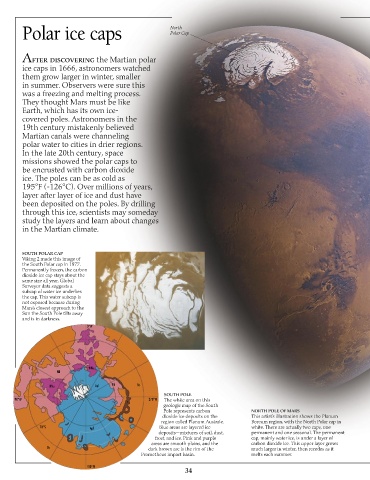
        SOUTH POLAR CAP
        Viking 2 made this image of
        the South Polar cap in 1977.
        Permanently frozen, the carbon
        dioxide ice cap stays about the
        same size all year. Global
        Surveyor data suggests a
        subcap of water ice underlies
        the cap. This water subcap is
        not exposed because during
        Mars’s closest approach to the
        Sun the South Pole tilts away
        and is in darkness.
                              0°W


                              HNu
                    Hd
                 HNu             Apl  Hd      Nc

                                                       SOUTH POLE
      90°W                                        270°W  The white area on this
                                           c
                                                       geologic map of the South
                                                       Pole represents carbon       NORTH POLE OF MARS
                                                       dioxide ice deposits on the   This artist’s illustration shows the Planum
                                                      region called Planum Australe.   Boreum region, with the North Polar cap in
              70°S             Apl                    Blue areas are layered ice    white. There are actually two caps, one
                                                     deposits—mixtures of soil, dust,   permanent and one seasonal. The permanent
                                                    frost, and ice. Pink and purple   cap, mainly water ice, is under a layer of
                                                   areas are smooth plains, and the   carbon dioxide ice. This upper layer grows
                 Nc                               dark brown arc is the rim of the   much larger in winter, then recedes as it
                                                Prometheus impact basin.            melts each summer.
                              180°W
                                                              34

