


Page 63 - (DK) Eyewitness - Mars
P. 63
Manned missions to Mars

      Mars swings closest to Earth every two years, when a trip between
      the two planets requires 180 days. September 2007 offers the next
      opportunity to launch a manned program to Mars, but likely is too
      soon. NASA is considering the launching of three landers loaded
      with gear, supplies, and an astronaut return-vehicle. Two years later,
      two more supply landers would be sent. These would be followed
      two years after that by a spacecraft with a crew. Manned missions
      then could be sent every two years.


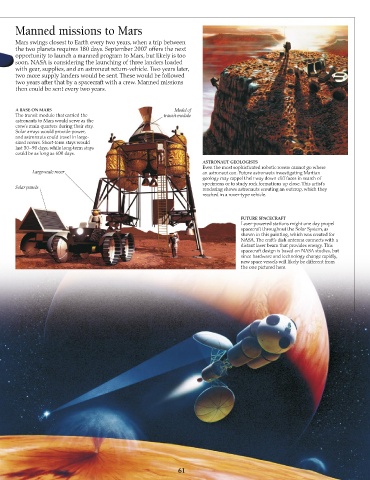
      A BASE ON MARS                                       Model of
      The transit module that carried the              transit module
      astronauts to Mars would serve as the
      crew’s main quarters during their stay.
      Solar arrays would provide power,
      and astronauts could travel in large-
      sized rovers. Short-term stays would
      last 30–90 days, while long-term stays
      could be as long as 600 days.
                                                                    ASTRONAUT GEOLOGISTS
                                                                    Even the most sophisticated robotic rovers cannot go where
            Large-scale rover                                       an astronaut can. Future astronauts investigating Martian
                                                                    geology may rappel their way down cliff faces in search of
                                                                    specimens or to study rock formations up close. This artist’s
      Solar panels                                                  rendering shows astronauts scouting an outcrop, which they
                                                                    reached in a rover-type vehicle.


                                                                                 FUTURE SPACECRAFT
                                                                                 Laser-powered stations might one day propel
                                                                                 spacecraft throughout the Solar System, as
                                                                                 shown in this painting, which was created for
                                                                                 NASA. The craft’s dish antenna connects with a
                                                                                 distant laser beam that provides energy. This
                                                                                 spacecraft design is based on NASA studies, but
                                                                                 since hardware and technology change rapidly,
                                                                                 new space vessels will likely be different from
                                                                                 the one pictured here.


                                                             1

