


Page 62 - (DK) Eyewitness - Mars
P. 62
Future exploration                                                                        Video camera   Sensors in wings

                                                                                                  in tail


         In coming years, a
         NASA Mars orbiter will release
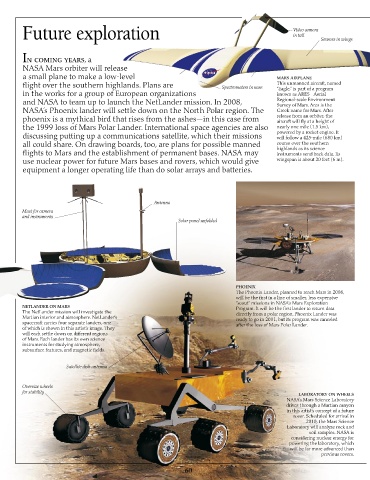
         a small plane to make a low-level                                                   MARS AIRPLANE
         flight over the southern highlands. Plans are                    Spectrometers in nose  This unmanned aircraft, named
                                                                                             “Eagle,” is part of a program
         in the works for a group of European organizations                                  known as ARES—Aerial
         and NASA to team up to launch the NetLander mission. In 2008,                       Regional-scale Environment
                                                                                             Survey of Mars. Ares is the
         NASA’s Phoenix lander will settle down on the North Polar region. The               Greek name for Mars. After
         phoenix is a mythical bird that rises from the ashes—in this case from              release from an orbiter, the
                                                                                             aircraft will fly at a height of
         the 1999 loss of Mars Polar Lander. International space agencies are also           nearly one mile (1.5 km),
         discussing putting up a communications satellite, which their missions              powered by a rocket engine. It
                                                                                             will follow a 425-mile (680 km)
         all could share. On drawing boards, too, are plans for possible manned              course over the southern
         flights to Mars and the establishment of permanent bases. NASA may                  highlands as its science
                                                                                             instruments send back data. Its
         use nuclear power for future Mars bases and rovers, which would give                wingspan is about 20 feet (6 m).
         equipment a longer operating life than do solar arrays and batteries.


                                                    Antenna
        Mast for camera
        and instruments
                                                            Solar panel unfolded


                                                                               PHOENIX
                                                                               The Phoenix Lander, planned to reach Mars in 2008,
                                                                               will be the first in a line of smaller, less expensive
                                                                               “scout” missions in NASA’s Mars Exploration
        NETLANDER ON MARS                                                      Program. It will be the first lander to return data
        The NetLander mission will investigate the                             directly from a polar region. Phoenix Lander was
        Martian interior and atmosphere. NetLander’s                           ready to go in 2001, but its program was canceled
        spacecraft carries four separate landers, one                          after the loss of Mars Polar Lander.
        of which is shown in this artist’s image. They
        will each settle down on different regions
        of Mars. Each lander has its own science
        instruments for studying atmosphere,
        subsurface features, and magnetic fields.

                       Satellite dish antenna


        Oversize wheels
        for stability
                                                                                                    LABORATORY ON WHEELS
                                                                                                NASA’s Mars Science Laboratory
                                                                                                drives through a Martian canyon
                                                                                                in this artist’s concept of a future
                                                                                                  rover. Scheduled for arrival in
                                                                                                      2010, the Mars Science
                                                                                                Laboratory will analyze rock and
                                                                                                       soil samples. NASA is
                                                                                                 considering nuclear energy for
                                                                                                 powering the laboratory, which
                                                                                                 will be far more advanced than
                                                                                                           previous rovers.

                                                               0

