


Page 64 - (DK) Eyewitness - Mars
P. 64
Colonizing Mars


                                    Once space agencies are able to land spacecraft on Mars and
                                    relaunch them safely back to Earth, the next step would be manned
                                    missions. Astronaut pioneers would set up small outposts, living on
                                    supplies from Earth. They would work to build a safe “Planetary
                                    Surface Environment,” as space scientists say. Colonization could
                                    follow, but permanent communities on Mars would need to be
                                    “biospheres”—places where plants can grow and fresh air is created.
                                    Researchers are developing large, airtight enclosures to serve as
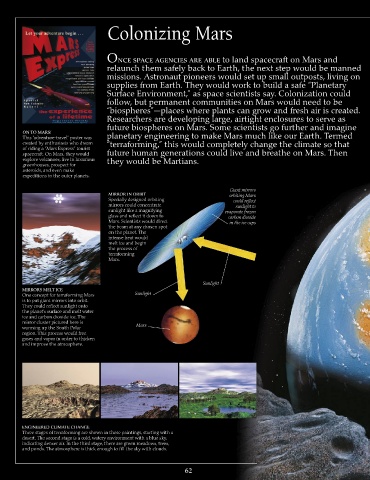
                                    future biospheres on Mars. Some scientists go further and imagine
         ON TO MARS!                planetary engineering to make Mars much like our Earth. Termed
         This “adventure-travel” poster was
         created by enthusiasts who dream   “terraforming,” this would completely change the climate so that
         of riding a “Mars Express” tourist
         spacecraft. On Mars, they would   future human generations could live and breathe on Mars. Then
         explore volcanoes, live in luxurious   they would be Martians.
         greenhouses, prospect for
         asteroids, and even make
         expeditions to the outer planets.

                                                                             Giant mirrors
                                     MIRROR IN ORBIT                         orbiting Mars
                                     Specially designed orbiting              could reflect
                                     mirrors could concentrate                 sunlight to
                                     sunlight like a magnifying            evaporate frozen
                                     glass and reflect it down to            carbon dioxide
                                     Mars. Scientists would direct           in the ice caps
                                     the beam at any chosen spot
                                     on the planet. The
                                     intense heat would
                                     melt ice and begin
                                     the process of
                                     terraforming
                                     Mars.


                                                                    Sunlight
        MIRRORS MELT ICE
        One concept for terraforming Mars     Sunlight
        is to put giant mirrors into orbit.
        They could reflect sunlight onto
        the planet’s surface and melt water
        ice and carbon dioxide ice. The
        mirror cluster pictured here is
        warming up the South Polar            Mars
        region. This process would free
        gases and vapor in order to thicken
        and improve the atmosphere.


        ENGINEERED CLIMATE CHANGE
        Three stages of terraforming are shown in these paintings, starting with a
        desert. The second stage is a cold, watery environment with a blue sky,
        indicating denser air. In the third stage, there are green meadows, trees,
        and ponds. The atmosphere is thick enough to fill the sky with clouds.


                                                               2

