


Page 170 - (DK Eyewitness) Travel Guide - The Netherlands
P. 170
168 WESTERN NE THERLANDS
Reclaimed Land
The Netherlands is continually increasing in size. Various
methods of reclaiming land have been employed as far back
as the 11th century. One fairly simple method was to build
a dyke around a marshy area. Later, deep lakes were drained
with the help of windmills. The far-reaching IJsselmeer
polders – fertile farmlands – were created after the Zuiderzee
was closed off using ingenious reclamation methods. Even
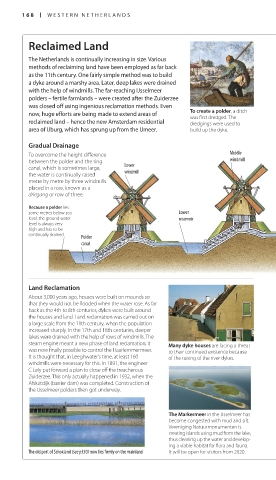
now, huge efforts are being made to extend areas of To create a polder, a ditch
was first dredged. The
reclaimed land – hence the new Amsterdam residential dredgings were used to
area of IJburg, which has sprung up from the IJmeer. build up the dyke.
Gradual Drainage
To overcome the height difference Middle
between the polder and the ring windmill
canal, which is sometimes large, Lower
windmill
the water is continually raised
metre by metre by three windmills
placed in a row, known as a
driegang or row of three.
Because a polder lies
some metres below sea Lower
level, the ground water reservoir
level is always very
high and has to be
continually drained. Polder
canal
Land Reclamation
About 3,000 years ago, houses were built on mounds so
that they would not be flooded when the water rose. As far
back as the 4th to 8th centuries, dykes were built around
the houses and land. Land reclamation was carried out on
a large scale from the 11th century, when the population
increased sharply. In the 17th and 18th centuries, deeper
lakes were drained with the help of rows of windmills. The
steam engine meant a new phase of land reclamation: it Many dyke houses are facing a threat
was now finally possible to control the Haarlemmermeer. to their continued existence because
It is thought that, in Leeghwater’s time, at least 160 of the raising of the river dykes.
windmills were necessary for this. In 1891, the engineer
C Lely put forward a plan to close off the treacherous
Zuiderzee. This only actually happened in 1932, when the
Afsluitdijk (barrier dam) was completed. Construction of
the IJsselmeer polders then got underway.
The Markermeer in the IJsselmeer has
become congested with mud and silt.
Vereniging Natuurmonumenten is
cre ating islands using mud from the lake,
thus cleaning up the water and develop
ing a viable habitat for flora and fauna.
The old port of Schokland (see p330) now lies firmly on the mainland It will be open for visitors from 2020.
168-169_EW_Netherlands.indd 168 16/01/17 11:54 am

