


Page 172 - (DK Eyewitness) Travel Guide - The Netherlands
P. 172
170 WESTERN NE THERLANDS
The Randstad
It appears that the term Randstad (literally, “rim
city”) was introduced by Albert Plesman, managing
director of Dutch airline KLM, which was
established in 1919. Apparently he pointed out
to the passengers on one of his airplanes the
horseshoe-shaped band of towns formed by
Utrecht, Amsterdam, Haarlem, Leiden, The
Hague, Rotterdam and Dordrecht. The relatively
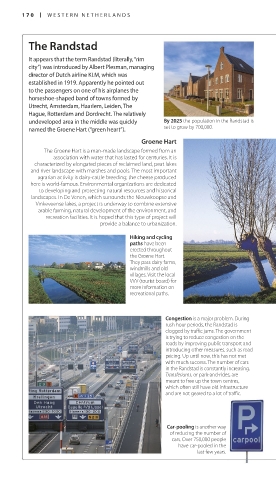
undeveloped area in the middle was quickly By 2025 the population in the Randstad is
named the Groene Hart (“green heart”). set to grow by 700,000.
Groene Hart
The Groene Hart is a man-made landscape formed from an
association with water that has lasted for centuries. It is
characterized by elongated pieces of reclaimed land, peat lakes
and river landscape with marshes and pools. The most important
agrarian activity is dairy-cattle breeding; the cheese produced
here is world-famous. Environmental organizations are dedicated
to developing and protecting natural resources and historical
landscapes. In De Venen, which surrounds the Nieuwkoopse and
Vinkeveense lakes, a project is underway to combine extensive
arable farming, natural development of the environment, and
recreation facilities. It is hoped that this type of project will
provide a balance to urbanization.
Hiking and cycling
paths have been
erected throughout
the Groene Hart.
They pass dairy farms,
windmills and old
villages. Visit the local
VVV (tourist board) for
more information on
recreational paths.
Congestion is a major problem. During
rush hour periods, the Randstad is
clogged by traffic jams. The government
is trying to reduce congestion on the
roads by improving public transport and
introducing other measures, such as road
pricing. Up until now, this has not met
with much success. The number of cars
in the Randstad is constantly increasing.
Transferiums, or park-and-rides, are
meant to free up the town centres,
which often still have old infrastructure
and are not geared to a lot of traffic.
Car-pooling is another way
of reducing the number of
cars. Over 750,000 people
have car-pooled in the
last few years.
170-171_EW_Netherlands.indd 170 16/01/17 11:54 am

