


Page 175 - (DK Eyewitness) Travel Guide - The Netherlands
P. 175
INTRODUCING THE WESTERN NE THERLANDS 173
Rabbits may look
cute, but they have
been known to
seriously undermine
the dunes with their
intricate network
of burrows.
Origins
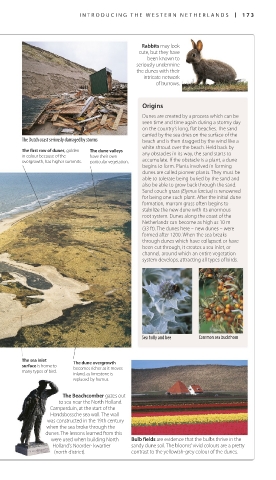
Dunes are created by a process which can be
seen time and time again during a stormy day
on the country’s long, flat beaches. The sand
carried by the sea dries on the surface of the
The Dutch coast seriously damaged by storms beach and is then dragged by the wind like a
white shroud over the beach. Held back by
A sea inlet is formed when The first row of dunes, golden The dune valleys any obstacles in its way, the sand starts to
the sea breaks through the in colour because of the have their own
row of dunes. overgrowth, has higher summits. particular vegetation. accumulate. If the obstacle is a plant, a dune
begins to form. Plants involved in forming
dunes are called pioneer plants. They must be
able to tolerate being buried by the sand and
also be able to grow back through the sand.
Sand couch grass (Elymus farctus) is renowned
for being one such plant. After the initial dune
formation, marram grass often begins to
stabilize the new dune with its enormous
root system. Dunes along the coast of the
Netherlands can become as high as 10 m
(33 ft). The dunes here – new dunes – were
formed after 1200. When the sea breaks
through dunes which have collapsed or have
been cut through, it creates a sea inlet, or
channel, around which an entire vegetation
system develops, attracting all types of birds.
Sea holly and bee Common sea buckthorn
The sea inlet The dune overgrowth
surface is home to becomes richer as it moves
many types of bird.
inland, as limestone is
replaced by humus.
The Beachcomber gazes out
to sea near the North Holland
Camperduin, at the start of the
Hondsbossche sea wall. The wall
was constructed in the 19th century
when the sea broke through the
dunes. The lessons learned from this
were used when building North Bulb fields are evidence that the bulbs thrive in the
Holland’s Noorder‑ kwartier sandy dune soil. The blooms’ vivid colours are a pretty
(north district). contrast to the yellowish‑grey colour of the dunes.
172-173_EW_Netherlands.indd 173 16/01/17 12:04 pm

