


Page 276 - (DK Eyewitness) Travel Guide - The Netherlands
P. 276
274 NOR THERN AND EASTERN NE THERLANDS
The Waddenzee
The Waddenzee is a tidal area whose sand or mud
flats (wadden) are mainly exposed at low tide and
disappear at high tide. Together with the West Frisian
Islands, the Waddenzee forms the last extensive wild
part of Holland. The entire area has an extremely
rich ecosystem because of the large sources of
nourishment. It is a feeding and breeding ground
for many species of birds. Two species of seal, 30
species of fish, shrimps and crabs live in the
Waddenzee or come here to breed. Cockles (Cardium edule), which
form the diet for many bird
species, are intensively harvested
using mechanical methods. The
catch is exported.
The VVVs (tourist
offices) on the West
Frisian Islands offer all
kinds of sailing trips
around the islands,
including romantic
luxury cruises on a
three-master. Rederij
Vooruit (tel. 0515-
531485) arranges
sailing trips on
local boats.
Sea Lavender
(Limonium vulgare),
along with sea purslane
and sea aster, grows in
the higher parts of the
salt marshes. Fields of
blue-violet sea lavender
flowers make a very
pretty sight.
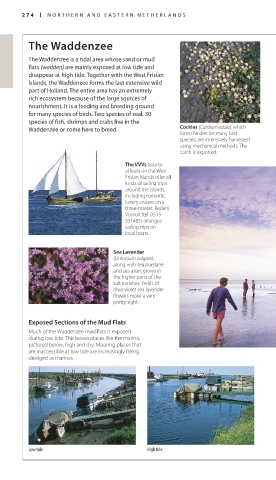
Exposed Sections of the Mud Flats
Much of the Waddenzee mud flats is exposed
during low tide. This leaves places like the marina,
pictured below, high and dry. Mooring places that
are inaccessible at low tide are increasingly being
dredged as marinas.
Low tide High tide
274-275_EW_Netherlands.indd 274 16/01/17 12:05 pm

