


Page 275 - (DK Eyewitness) Travel Guide - The Netherlands
P. 275
THE WEST FRISIAN ISLANDS 273
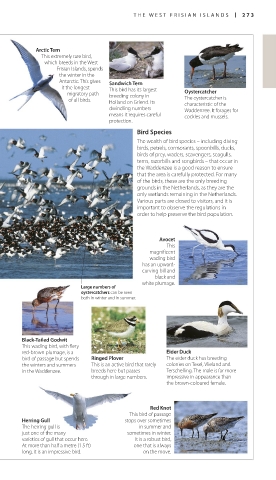
Arctic Tern
This extremely rare bird,
which breeds in the West
Frisian Islands, spends
the winter in the
Antarctic. This gives Sandwich Tern
it the longest This bird has its largest
migratory path breeding colony in Oystercatcher
of all birds. Holland on Griend. Its The oystercatcher is
dwindling numbers characteristic of the
Waddenzee. It forages for
means it requires careful cockles and mussels.
protection.
Bird Species
The wealth of bird species – including diving
birds, petrels, cormorants, spoonbills, ducks,
birds of prey, waders, scavengers, seagulls,
terns, razorbills and songbirds – that occur in
the Waddenzee is a good reason to ensure
that the area is carefully protected. For many
of the birds, these are the only breeding
grounds in the Netherlands, as they are the
only wetlands remaining in the Netherlands.
Various parts are closed to visitors, and it is
important to observe the regulations in
order to help preserve the bird population.
Avocet
This
magnificent
wading bird
has an upward-
curving bill and
black and
white plumage.
Large numbers of
oystercatchers can be seen
both in winter and in summer.
Black-Tailed Godwit
This wading bird, with fiery
red-brown plumage, is a Eider Duck
bird of passage but spends Ringed Plover The eider duck has breeding
the winters and summers This is an active bird that rarely colonies on Texel, Vlieland and
in the Waddenzee. breeds here but passes Terschelling. The male is far more
through in large numbers. impressive in appearance than
the brown-coloured female.
Red Knot
This bird of passage
Herring Gull stops over sometimes
The herring gull is in summer and
just one of the many sometimes in winter.
varieties of gull that occur here. It is a robust bird,
At more than half a metre (1.5 ft) one that is always
long, it is an impressive bird. on the move.
272-273_EW_Netherlands.indd 273 16/01/17 12:05 pm

