


Page 107 - (DK) Help Your Kids with Language Arts
P. 107
105
                                                                             APO S TROPHE S


          • Place an apostrophe where letters have been omitted.
          This is not always where the words have joined.
          • Another way to form the possessive of a noun is
          to swap the position of the owner and the item it    Apostrophes frequently appear
          owns and connect them with the word of. For example,
          instead of writing “the Netherlands’s tulips,” write   in non-English surnames, such as
          “the tulips of the Netherlands.”                O’Neill, N’Dor, and D’Agostino.


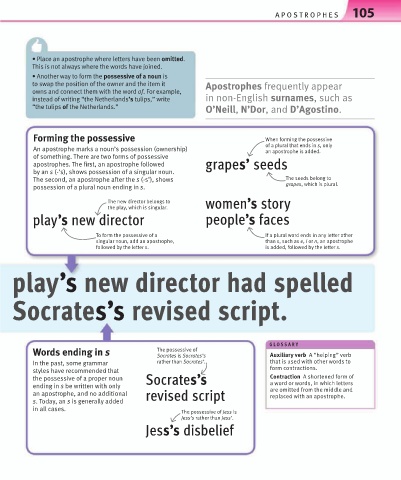
          Forming the possessive                                          When forming the possessive
                                                                          of a plural that ends in s, only
          An apostrophe marks a noun’s possession (ownership)             an apostrophe is added.
          of something. There are two forms of possessive
          apostrophes. The first, an apostrophe followed    grapes’ seeds
          by an s (-’s), shows possession of a singular noun.
          The second, an apostrophe after the s (-s’), shows                    The seeds belong to
                                                                                grapes, which is plural.
          possession of a plural noun ending in s.
                               The new director belongs to   women’s story
                               the play, which is singular.
          play’s new director                             people’s faces

                           To form the possessive of a                    If a plural word ends in any letter other
                           singular noun, add an apostrophe,              than s, such as e, i or n, an apostrophe
                           followed by the letter s.                      is added, followed by the letter s.


    play’s new director had spelled


    Socrates’s revised script.


                                                                           GLO S S A RY
          Words ending in s                 The possessive of
                                            Socrates is Socrates’s         Auxiliary verb  A “helping” verb
          In the past, some grammar         rather than Socrates’.         that is used with other words to
          styles have recommended that                                     form contractions.
          the possessive of a proper noun   Socrates’s                     Contraction  A shortened form of
          ending in s be written with only                                 a word or words, in which letters
                                                                           are omitted from the middle and
          an apostrophe, and no additional   revised script                replaced with an apostrophe.
          s. Today, an s is generally added
          in all cases.
                                                   The possessive of Jess is
                                                   Jess’s rather than Jess’.
                                         Jess’s disbelief

