


Page 108 - (DK) Help Your Kids with Language Arts
P. 108
106 PUNCTU A TION
Hyphens SEE ALSO
26–27 Adjectives
HYPHENS ARE USED TO EITHER JOIN OR 56–57 Phrasal verbs
Numbers, dates, and time 118–119
SEPARATE WORDS OR PARTS OF WORDS.
Alphabetical order 128–129
Syllables 134–135
Sometimes two terms need to be shown to be connected, so that they
Roots 140–141
are treated as one. Alternatively, a separation between terms may need
Prefixes and suffixes 142–143
to be emphasized. A hyphen can be used for both of these purposes.
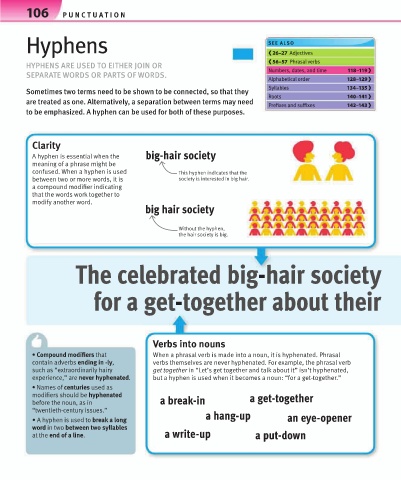
Clarity
A hyphen is essential when the big-hair society
meaning of a phrase might be
confused. When a hyphen is used This hyphen indicates that the
between two or more words, it is society is interested in big hair.
a compound modifier indicating
that the words work together to
modify another word.
big hair society
Without the hyphen,
the hair society is big.
The celebrated big-hair society
for a get-together about their
Verbs into nouns
• Compound modifiers that When a phrasal verb is made into a noun, it is hyphenated. Phrasal
contain adverbs ending in -ly, verbs themselves are never hyphenated. For example, the phrasal verb
such as “extraordinarily hairy get together in “Let’s get together and talk about it” isn’t hyphenated,
experience,” are never hyphenated. but a hyphen is used when it becomes a noun: “for a get-together.”
• Names of centuries used as
modifiers should be hyphenated a get-together
before the noun, as in a break-in
“twentieth-century issues.”
• A hyphen is used to break a long a hang-up an eye-opener
word in two between two syllables
at the end of a line. a write-up a put-down

