


Page 42 - (DK) Help Your Kids with Language Arts
P. 42
40 GRAMMAR
Adverbs SEE ALSO
26–27 Adjectives
AN ADVERB MODIFIES A VERB, AN ADJECTIVE, OR ANOTHER ADVERB. 28–29 Comparatives and superlatives
38–39 Verbs
Conjunctions 58–59
The word adverb essentially means “to add to a verb,” and this is
Phrases 64–65
what adverbs mostly do. They provide information about how, when,
Clauses 66–67
where, or how often something is happening, and to what degree. Managing modifiers 76–77
When and how often? Where?
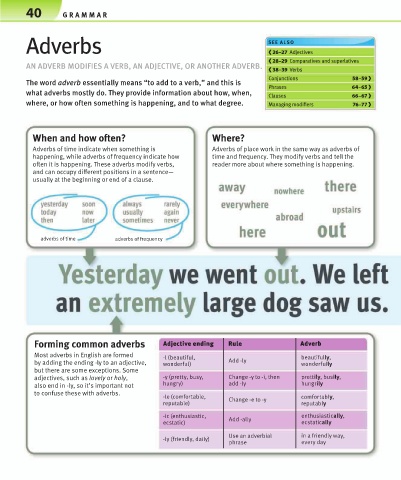
Adverbs of time indicate when something is Adverbs of place work in the same way as adverbs of
happening, while adverbs of frequency indicate how time and frequency. They modify verbs and tell the
often it is happening. These adverbs modify verbs, reader more about where something is happening.
and can occupy different positions in a sentence—
usually at the beginning or end of a clause.
adverbs of time adverbs of frequency
Forming common adverbs Adjective ending Rule Adverb
Most adverbs in English are formed -l (beautiful, beautifully,
by adding the ending -ly to an adjective, wonderful) Add -ly wonderfully
but there are some exceptions. Some
adjectives, such as lovely or holy, -y (pretty, busy, Change -y to -i, then prettily, busily,
also end in -ly, so it’s important not hungry) add -ly hungrily
to confuse these with adverbs.
-le (comfortable, comfortably,
reputable) Change -e to -y reputably
-ic (enthusiastic, enthusiastically,
ecstatic) Add -ally ecstatically
Use an adverbial in a friendly way,
-ly (friendly, daily)
phrase every day

