


Page 107 - (DK) Ocean - The Definitive Visual Guide
P. 107
105


                                     Coastal Defenses


                                     Coastal defense refers to various types of engineering
                                                                                         TYPES OF DEFENSES
                                     techniques aimed at protecting coasts from the sea. The
                                     threats posed by the sea fall into two main categories.                 SEA WALL  A sea wall is
                                                                                                             designed to reflect wave energy.
                                     First is the danger of flooding of low-lying coastal
                                                                                                             Modern walls have a curved top
                                     areas during severe storms. Second is the continuous                    that prevents water from spraying
                                                                                                             over the wall in storms. A wall
                                     gradual erosion of some coasts. There are a number
                                                                                                             protects the land behind it for
                                     of different approaches to coastal defense. To prevent                  some years but usually increases
                                     flooding of low-lying regions, one solution is to                       erosion of the beach in front of it.
                                     build a large-scale system of dams and tidal barriers.
                                     Another is to encourage the development of natural
                                     barriers, such as salt marshes, around coasts, and to
                                     conserve existing areas of this type. A third possibility   ROCK GROYNE  This
                                     is managed retreat. Instead of trying to hold back    consists of a pile of large
                                     the sea, some areas of coast are allowed to flood.    HARD ENGINEERING  rocks built out from the
                                                                                         shore. The aim is to slow
                                     The idea is that, in time, the flooded land will turn   erosion by causing a local
                                     into a marsh, providing natural protection.         buildup of sand, but it can
                                      To slow coastal erosion, various “hard” engineering   aggravate erosion nearby.
                                     techniques are commonly employed, such as the
                                                                                                             DUNE STABILIZATION  Coastal
                                     building of sea walls, breakwaters, or groynes. These                   dunes provide valuable protection
                                     methods can be effective for a while (they usually                      against erosion if they can be
                                                                                                             stabilized and prevented from
                                     have to be rebuilt after a few decades), but are                        shifting. This is usually achieved
                                     expensive and can increase erosion on neighboring                       by planting
                                                                                                             with grasses.
                                     areas of coast by interfering with longshore movement
                                     of sediment. “Soft” engineering techniques are more
                                     environmentally friendly. They include the temporary
                                     solution of beach nourishment (see panel, right),   BEACH NOURISHMENT
                                     which has to be repeated every few years, and       This involves adding large
                                     encouraging the development of coastal dunes.     SOFT ENGINEERING  amounts of sand to a beach.
                                                                                         Waves and tides spread the
                                                                                         material along the coast,
                                     Crumbling Coasts                                    temporarily building up
                                                                                         its natural defenses.
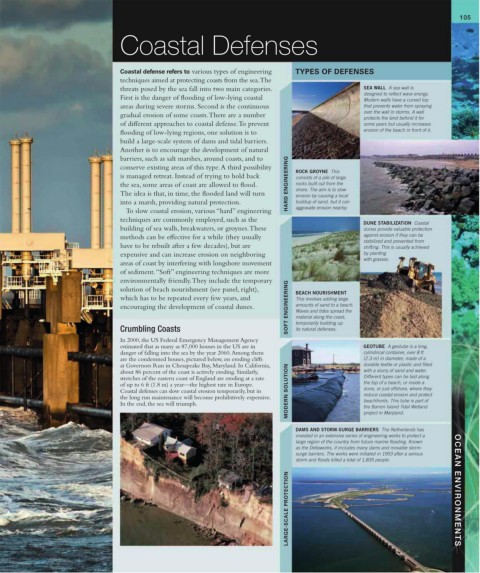
                                     In 2000, the US Federal Emergency Management Agency
                                     estimated that as many as 87,000 houses in the US are in                GEOTUBE  A geotube is a long,
                                     danger of falling into the sea by the year 2060. Among them             cylindrical container, over 8 ft
                                     are the condemned houses, pictured below, on eroding cliffs             (2.3 m) in diameter, made of a
                                     at Governors Run in Chesapeake Bay, Maryland. In California,            durable textile or plastic and filled
                                     about 86 percent of the coast is actively eroding. Similarly,           with a slurry of sand and water.
                                     stretches of the eastern coast of England are eroding at a rate         Different types can be laid along
                                     of up to 6 ft (1.8 m) a year—the highest rate in Europe.                the top of a beach, or inside a
                                     Coastal defenses can slow coastal erosion temporarily, but in    MODERN SOLUTION  dune, or just offshore, where they
                                                                                                             reduce coastal erosion and protect
                                     the long run maintenance will become prohibitively expensive.           beachfronts. This tube is part of
                                     In the end, the sea will triumph.                                       the Barren Island Tidal Wetland
                                                                                                             project in Maryland.


                                                                                         DAMS AND STORM-SURGE BARRIERS  The Netherlands has
                                                                                         invested in an extensive series of engineering works to protect a
                                                                                         large region of the country from future marine flooding. Known
                                                                                         as the Deltaworks, it includes many dams and movable storm-
                                                                                         surge barriers. The works were initiated in 1953 after a serious
                                                                                         storm and floods killed a total of 1,835 people.

                                                                                       LARGE-SCALE PROTECTION                            OCEAN ENVIRONMENTS

