


Page 108 - (DK) Ocean - The Definitive Visual Guide
P. 108
106     COASTS AND THE SEASHORE


               Beaches and Dunes


               BEACHES ARE DEPOSITS OF SEDIMENTARY MATERIAL, ranging in size
               from fine sand to rocks, that commonly occur on coasts above the
               low-tide line. Sources of beach material include sediment brought to
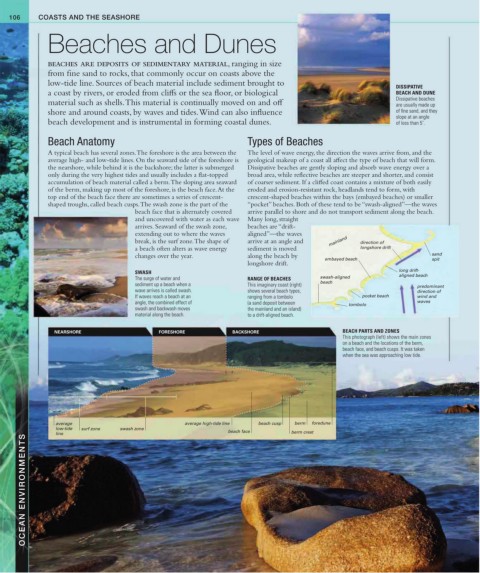
                                                                                                                       DISSIPATIVE
               a coast by rivers, or eroded from cliffs or the sea floor, or biological                                BEACH AND DUNE
                                                                                                                       Dissipative beaches
               material such as shells. This material is continually moved on and off                                  are usually made up
               shore and around coasts, by waves and tides. Wind can also influence                                    of fine sand, and they
                                                                                                                       slope at an angle
               beach development and is instrumental in forming coastal dunes.                                         of less than 5˚.


               Beach Anatomy                                               Types of Beaches
               A typical beach has several zones. The foreshore is the area between the   The level of wave energy, the direction the waves arrive from, and the
               average high- and low-tide lines. On the seaward side of the foreshore is   geological makeup of a coast all affect the type of beach that will form.
               the nearshore, while behind it is the backshore; the latter is submerged   Dissipative beaches are gently sloping and absorb wave energy over a
               only during the very highest tides and usually includes a flat-topped   broad area, while reflective beaches are steeper and shorter, and consist
               accumulation of beach material called a berm. The sloping area seaward   of coarser sediment. If a cliffed coast contains a mixture of both easily
               of the berm, making up most of the foreshore, is the beach face. At the   eroded and erosion-resistant rock, headlands tend to form, with
               top end of the beach face there are sometimes a series of crescent-  crescent-shaped beaches within the bays (embayed beaches) or smaller
               shaped troughs, called beach cusps. The swash zone is the part of the   “pocket” beaches. Both of these tend to be “swash-aligned”—the waves
                                         beach face that is alternately covered   arrive parallel to shore and do not transport sediment along the beach.
                                         and uncovered with water as each wave  Many long, straight
                                         arrives. Seaward of the swash zone,   beaches are “drift-
                                         extending out to where the waves   aligned”—the waves
                                         break, is the surf zone. The shape of    arrive at an angle and   mainland  direction of
                                         a beach often alters as wave energy   sediment is moved            longshore drift
                                         changes over the year.            along the beach by                                     sand
                                                                                                  embayed beach                   spit
                                                                           longshore drift.
                                                                                                                        long drift-
                                         SWASH                                                                          aligned beach
                                         The surge of water and            RANGE OF BEACHES     swash-aligned
                                         sediment up a beach when a        This imaginary coast (right)   beach              predominant
                                         wave arrives is called swash.     shows several beach types,                        direction of
                                         If waves reach a beach at an      ranging from a tombolo            pocket beach    wind and
                                         angle, the combined effect of     (a sand deposit between       tombolo             waves
                                         swash and backwash moves          the mainland and an island)
                                         material along the beach.         to a drift-aligned beach.

                                                                                                       BEACH PARTS AND ZONES
                 NEARSHORE                      FORESHORE             BACKSHORE
                                                                                                       This photograph (left) shows the main zones
                                                                                                       on a beach and the locations of the berm,
                                                                                                       beach face, and beach cusps. It was taken
                                                                                                       when the sea was approaching low tide.


                 average                                average high-tide line  beach cusp  berm  foredune
                 low-tide    surf zone  swash zone
                 line                                                beach face         berm crest
        OCEAN ENVIRONMENTS

