


Page 109 - (DK) Ocean - The Definitive Visual Guide
P. 109
107


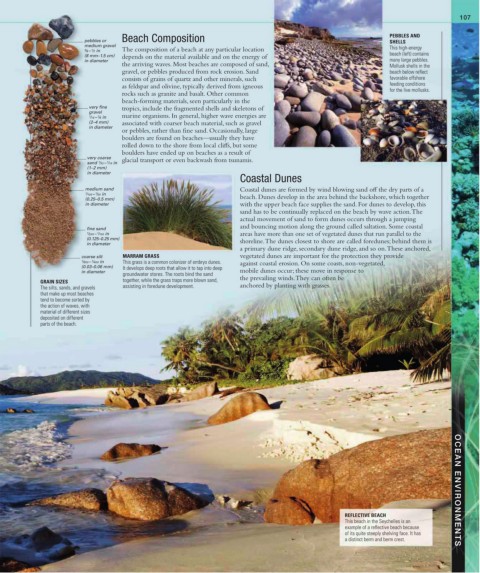
                                     Beach Composition                                                               PEBBLES AND
                          pebbles or                                                                                 SHELLS
                          medium gravel                                                                              This high-energy
                          3 /8 –  1 /2 in    The composition of a beach at any particular location
                          (8 mm–1.5 cm)    depends on the material available and on the energy of                    beach (left) contains
                          in diameter                                                                                many large pebbles.
                                     the arriving waves. Most beaches are composed of sand,                          Mollusk shells in the
                                     gravel, or pebbles produced from rock erosion. Sand                             beach below reflect
                                     consists of grains of quartz and other minerals, such                           favorable offshore
                                     as feldspar and olivine, typically derived from igneous                         feeding conditions
                                                                                                                     for the live mollusks.
                                     rocks such as granite and basalt. Other common
                                     beach-forming materials, seen particularly in the
                           very fine   tropics, include the fragmented shells and skeletons of
                           gravel
                           1 /16 –  1 /8 in    marine organisms. In general, higher wave energies are
                           (2–4 mm)    associated with coarser beach material, such as gravel
                           in diameter
                                     or pebbles, rather than fine sand. Occasionally, large
                                     boulders are found on beaches—usually they have
                                     rolled down to the shore from local cliffs, but some
                                     boulders have ended up on beaches as a result of
                           very coarse   glacial transport or even backwash from tsunamis.
                           sand  1 /32 –  1 /16 in
                           (1–2 mm)
                           in diameter
                                                                        Coastal Dunes
                          medium sand                                   Coastal dunes are formed by wind blowing sand off the dry parts of a
                          1 /100 –  1 /50 in
                                                                        beach. Dunes develop in the area behind the backshore, which together
                          (0.25–0.5 mm)
                          in diameter                                   with the upper beach face supplies the sand. For dunes to develop, this
                                                                        sand has to be continually replaced on the beach by wave action. The
                                                                        actual movement of sand to form dunes occurs through a jumping
                                                                        and bouncing motion along the ground called saltation. Some coastal
                           fine sand
                                                                        areas have more than one set of vegetated dunes that run parallel to the
                           1 /200 –  1 /100 in
                           (0.125–0.25 mm)
                           in diameter                                  shoreline. The dunes closest to shore are called foredunes; behind them is
                                                                        a primary dune ridge, secondary dune ridge, and so on. These anchored,
                         coarse silt  MARRAM GRASS                      vegetated dunes are important for the protection they provide
                         1 /850 –  1 /400 in   This grass is a common colonizer of embryo dunes.    against coastal erosion. On some coasts, non-vegetated,
                         (0.03–0.06 mm)    It develops deep roots that allow it to tap into deep
                         in diameter                                    mobile dunes occur; these move in response to
                                     groundwater stores. The roots bind the sand
             GRAIN SIZES             together, while the grass traps more blown sand,   the prevailing winds. They can often be
             The silts, sands, and gravels   assisting in foredune development.  anchored by planting with grasses.
             that make up most beaches
             tend to become sorted by
             the action of waves, with
             material of different sizes
             deposited on different
             parts of the beach.


                                                                                                        REFLECTIVE BEACH                 OCEAN ENVIRONMENTS
                                                                                                        This beach in the Seychelles is an
                                                                                                        example of a reflective beach because
                                                                                                        of its quite steeply shelving face. It has
                                                                                                        a distinct berm and berm crest.

