Page 112 - (DK) Ocean - The Definitive Visual Guide
P. 112
110


                                                                              ATLANTIC OCEAN NORTHEAST      ATLANTIC OCEAN EAST
                                                                           Cap Ferret                   Banc d’Arguin

                                                                                         TYPE  Coastal dunes on        TYPE  Coastal dunes and
                                                                                         a spit                        tidal flats
                                                                                         COMPOSITION  Sand,            COMPOSITION  Yellow
                                                                                         grasses, forest               sand
                                                                                              1
                                                                                         LENGTH  7 / 2 miles (12 km)   LENGTH  100 miles
                                                                                                                       (160 km)
                                                                           LOCATION   Coast of Aquitaine, southwest of   LOCATION  Between Nouakchott and Nouadhibou on
                                                                           Bordeaux, southwestern France  the northwest coast of Mauritania, West Africa
                                                                           Cap Ferret lies at the southern end of   The Banc d’Arguin National Park
                                                                           a long sand spit in western France. It   is a vast region of dunes, islands, and
                                                                           separates the Arcachon Lagoon from   shallow tidal flats covering more than
                                                                           the Atlantic Ocean and forms part of   4,600 square miles (12,000 square km)
                                                                           the spectacular Aquitaine coast, which   of the Mauritanian coast. The dunes,
                                                                           at 143 miles (230 km) is the longest   which consist mainly of windblown
                                                                           sandy coast in Europe. This region is   sand from the Sahara, are concentrated
                                                                           characterized by a series of straight,   in the southern region of the Park.
                                                                           sandy beaches backed by longitudinal   Banc d’Arguin contains a variety of
                                                                           sand dunes, which are the highest dune   plant life and is a major breeding or
                                                                           formations in Europe. They include   wintering site for many migratory
                                                                           the highest individual European sand   birds, including flamingos, pelicans,
                                                                           dune, the Dune du Pilat, which rises   and terns. It was declared a World
                                                                           to about 380 ft (115 m) above sea level.   Heritage Site in 1987.
                                                                             Behind the main dune area is a
                                                                           forest, originally planted in the 18th
                                                                           century to try to prevent the dunes
                                                                           from shifting. Unfortunately, this coast
                                                                           is undergoing serious erosion, of more
                                                                           than 33 ft (10 m) a year in some
                                                                           places, mainly because excessive urban
                                                                           development has degraded the
                                                                           vegetation cover.
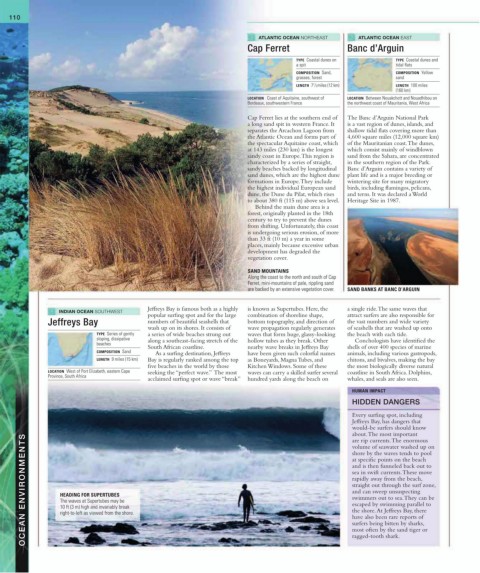
                                                                           SAND MOUNTAINS
                                                                           Along the coast to the north and south of Cap
                                                                           Ferret, mini-mountains of pale, rippling sand
                                                                           are backed by an extensive vegetation cover.  SAND BANKS AT BANC D’ARGUIN


                                             Jeffreys Bay is famous both as a highly   is known as Supertubes. Here, the   a single ride. The same waves that
                  INDIAN OCEAN SOUTHWEST
                                             popular surfing spot and for the large   combination of shoreline shape,   attract surfers are also responsible for
               Jeffreys Bay                  numbers of beautiful seashells that   bottom topography, and direction of   the vast numbers and wide variety
                                             wash up on its shores. It consists of    wave propagation regularly generates   of seashells that are washed up onto
                              TYPE  Series of gently   a series of wide beaches strung out   waves that form huge, glassy-looking   the beach with each tide.
                              sloping, dissipative   along a southeast-facing stretch of the   hollow tubes as they break. Other   Conchologists have identified the
                              beaches
                                             South African coastline.      nearby wave breaks in Jeffreys Bay   shells of over 400 species of marine
                              COMPOSITION  Sand  As a surfing destination, Jeffreys   have been given such colorful names   animals, including various gastropods,
                              LENGTH  9 miles (15 km)   Bay is regularly ranked among the top   as Boneyards, Magna Tubes, and   chitons, and bivalves, making the bay
                                             five beaches in the world by those   Kitchen Windows. Some of these   the most biologically diverse natural
               LOCATION  West of Port Elizabeth, eastern Cape   seeking the “perfect wave.”  The most   waves can carry a skilled surfer several   coastline in South Africa. Dolphins,
               Province, South Africa
                                             acclaimed surfing spot or wave “break”  hundred yards along the beach on    whales, and seals are also seen.
                                                                                                          HUMAN IMPACT
                                                                                                          HIDDEN DANGERS

                                                                                                          Every surfing spot, including
                                                                                                          Jeffreys Bay, has dangers that
                                                                                                          would-be surfers should know
                                                                                                          about. The most important
        OCEAN ENVIRONMENTS  HEADING FOR SUPERTUBES                                                        and is then funneled back out to
                                                                                                          are rip currents. The enormous
                                                                                                          volume of seawater washed up on
                                                                                                          shore by the waves tends to pool
                                                                                                          at specific points on the beach

                                                                                                          sea in swift currents. These move
                                                                                                          rapidly away from the beach,
                                                                                                          straight out through the surf zone,
                                                                                                          and can sweep unsuspecting
                                                                                                          swimmers out to sea. They can be
                   The waves at Supertubes may be
                                                                                                          escaped by swimming parallel to
                   10 ft (3 m) high and invariably break
                                                                                                          the shore. At Jeffreys Bay, there
                   right-to-left as viewed from the shore.
                                                                                                          have also been rare reports of
                                                                                                          surfers being bitten by sharks,
                                                                                                          most often by the sand tiger or
                                                                                                          ragged-tooth shark.
   107   108   109   110   111   112   113   114   115   116   117