Page 145 - (DK) Ocean - The Definitive Visual Guide
P. 145
143


                                                             Vertical Rock

                                                             Underwater cliffs are often more heavily
                                                             colonized with invertebrates than gently sloping
                                                             rocks. In shallow water exposed to strong waves,
                                                             various mobile seabed animals, particularly
                                                             grazing sea urchins and predatory starfish, find
                                                             it harder to cling to vertical and overhanging
                                                             surfaces, and are knocked off by waves in rough
                                                             weather. Vertical walls receive less sunlight, and
                                                             are harder places for seaweed spores to settle, so
                                                             there is less competition from seaweeds here
                                                             than on horizontal rock. At sheltered sites,
                                                             upward-facing rock is often covered with silt, and
                                                             has few animals, but vertical and overhanging
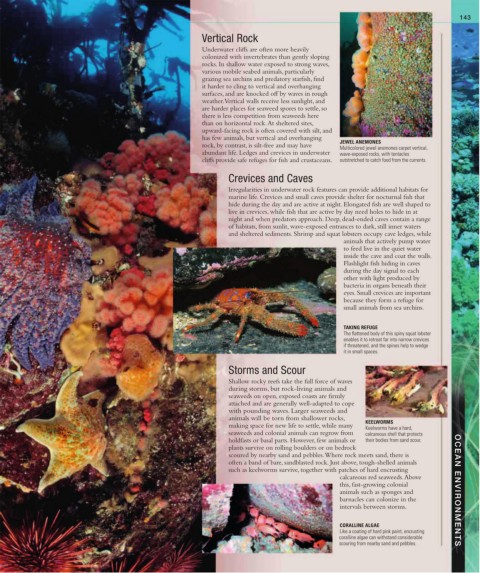
                                                             rock, by contrast, is silt-free and may have   JEWEL ANEMONES
                                                                                                      Multicolored jewel anemones carpet vertical,
                                                             abundant life. Ledges and crevices in underwater   wave-exposed rocks, with tentacles
                                                             cliffs provide safe refuges for fish and crustaceans.   outstretched to catch food from the currents.

                                                                     Crevices and Caves

                                                                     Irregularities in underwater rock features can provide additional habitats for
                                                                     marine life. Crevices and small caves provide shelter for nocturnal fish that
                                                                     hide during the day and are active at night. Elongated fish are well shaped to
                                                                     live in crevices, while fish that are active by day need holes to hide in at
                                                                     night and when predators approach. Deep, dead-ended caves contain a range
                                                                     of habitats, from sunlit, wave-exposed entrances to dark, still inner waters
                                                                     and sheltered sediments. Shrimp and squat lobsters occupy cave ledges, while
                                                                                                       animals that actively pump water
                                                                                                       to feed live in the quiet water
                                                                                                       inside the cave and coat the walls.
                                                                                                       Flashlight fish hiding in caves
                                                                                                       during the day signal to each
                                                                                                       other with light produced by
                                                                                                       bacteria in organs beneath their
                                                                                                       eyes. Small crevices are important
                                                                                                       because they form a refuge for
                                                                                                       small animals from sea urchins.


                                                                                                       TAKING REFUGE
                                                                                                       The flattened body of this spiny squat lobster
                                                                                                       enables it to retreat far into narrow crevices
                                                                                                       if threatened, and the spines help to wedge
                                                                                                       it in small spaces.

                                                                     Storms and Scour
                                                                     Shallow rocky reefs take the full force of waves
                                                                     during storms, but rock-living animals and
                                                                     seaweeds on open, exposed coasts are firmly
                                                                     attached and are generally well-adapted to cope
                                                                     with pounding waves. Larger seaweeds and
                                                                     animals will be torn from shallower rocks,
                                                                                                              KEELWORMS
                                                                     making space for new life to settle, while many   Keelworms have a hard,
                                                                     seaweeds and colonial animals can regrow from   calcareous shell that protects
                                                                     holdfasts or basal parts. However, few animals or   their bodies from sand scour.
                                                                     plants survive on rolling boulders or on bedrock
                                                                     scoured by nearby sand and pebbles. Where rock meets sand, there is
                                                                     often a band of bare, sandblasted rock. Just above, tough-shelled animals
                                                                     such as keelworms survive, together with patches of hard encrusting
                                                                                                      calcareous red seaweeds. Above
                                                                                                      this, fast-growing colonial
                                                                                                      animals such as sponges and        OCEAN ENVIRONMENTS
                                                                                                      barnacles can colonize in the
                                                                                                      intervals between storms.


                                                                                                      CORALLINE ALGAE
                                                                                                      Like a coating of hard pink paint, encrusting
                                                                                                      coralline algae can withstand considerable
                                                                                                      scouring from nearby sand and pebbles.
   140   141   142   143   144   145   146   147   148   149   150