


Page 144 - (DK) Ocean - The Definitive Visual Guide
P. 144
142     SHALLOW SEAS


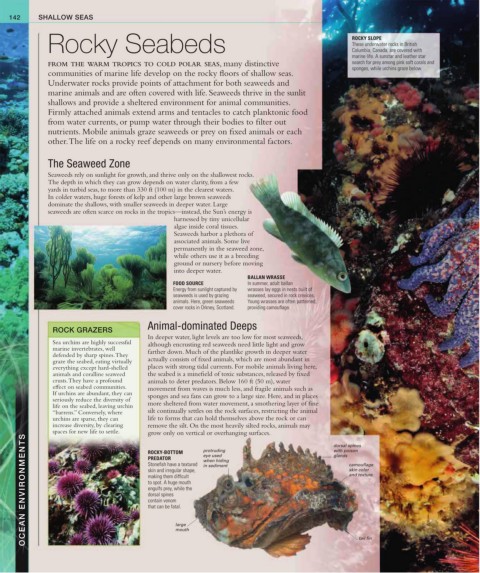
               Rocky Seabeds                                                                              ROCKY SLOPE
                                                                                                          These underwater rocks in British
                                                                                                          Columbia, Canada, are covered with
                                                                                                          marine life. A sunstar and leather star
               FROM THE WARM TROPICS TO COLD POLAR SEAS, many distinctive                                 search for prey among pink soft corals and
                                                                                                          sponges, while urchins graze below.
               communities of marine life develop on the rocky floors of shallow seas.
               Underwater rocks provide points of attachment for both seaweeds and
               marine animals and are often covered with life. Seaweeds thrive in the sunlit
               shallows and provide a sheltered environment for animal communities.
               Firmly attached animals extend arms and tentacles to catch planktonic food
               from water currents, or pump water through their bodies to filter out
               nutrients. Mobile animals graze seaweeds or prey on fixed animals or each
               other. The life on a rocky reef depends on many environmental factors.


               The Seaweed Zone
               Seaweeds rely on sunlight for growth, and thrive only on the shallowest rocks.
               The depth in which they can grow depends on water clarity, from a few
               yards in turbid seas, to more than 330 ft (100 m) in the clearest waters.
               In colder waters, huge forests of kelp and other large brown seaweeds
               dominate the shallows, with smaller seaweeds in deeper water. Large
               seaweeds are often scarce on rocks in the tropics—instead, the Sun’s energy is
                                                     harnessed by tiny unicellular
                                                     algae inside coral tissues.
                                                     Seaweeds harbor a plethora of
                                                     associated animals. Some live
                                                     permanently in the seaweed zone,
                                                     while others use it as a breeding
                                                     ground or nursery before moving
                                                     into deeper water.
                                                                           BALLAN WRASSE
                                                     FOOD SOURCE           In summer, adult ballan
                                                     Energy from sunlight captured by   wrasses lay eggs in nests built of
                                                     seaweeds is used by grazing   seaweed, secured in rock crevices.
                                                     animals. Here, green seaweeds   Young wrasses are often patterned,
                                                     cover rocks in Orkney, Scotland.   providing camouflage.


                 ROCK GRAZERS                Animal-dominated Deeps
                                             In deeper water, light levels are too low for most seaweeds,
                 Sea urchins are highly successful   although encrusting red seaweeds need little light and grow
                 marine invertebrates, well   farther down. Much of the plantlike growth in deeper water
                 defended by sharp spines. They
                 graze the seabed, eating virtually   actually consists of fixed animals, which are most abundant in
                 everything except hard-shelled   places with strong tidal currents. For mobile animals living here,
                 animals and coralline seaweed   the seabed is a minefield of toxic substances, released by fixed
                 crusts. They have a profound   animals to deter predators. Below 160 ft (50 m), water
                 effect on seabed communities.    movement from waves is much less, and fragile animals such as
                 If urchins are abundant, they can   sponges and sea fans can grow to a large size. Here, and in places
                 seriously reduce the diversity of
                 life on the seabed, leaving urchin   more sheltered from water movement, a smothering layer of fine
                 “barrens.” Conversely, where   silt continually settles on the rock surfaces, restricting the animal
                 urchins are sparse, they can   life to forms that can hold themselves above the rock or can
                 increase diversity, by clearing   remove the silt. On the most heavily silted rocks, animals may
                 spaces for new life to settle.   grow only on vertical or overhanging surfaces.    dorsal spines
        OCEAN ENVIRONMENTS                   Stonefish have a textured   in sediment                      camouflage

                                                                                                    with poison
                                                             protruding
                                             ROCKY-BOTTOM
                                                                                                    glands
                                                             eye used
                                             PREDATOR
                                                             when hiding
                                                                                                         skin color
                                             skin and irregular shape,
                                                                                                         and texture
                                             making them difficult
                                             to spot. A huge mouth
                                             engulfs prey, while the
                                             dorsal spines
                                             contain venom
                                             that can be fatal.
                                                     large
                                                     mouth
                                                                                                            tail fin

