


Page 149 - (DK) Ocean - The Definitive Visual Guide
P. 149
SEAGRASS BEDS AND KELP FORESTS              147


             Kelp Communities                                                   Nurseries and Refuges

             Many kelps are treelike in shape, with a branched                  Seagrass beds and kelp forests are important refuges for young
             holdfast for attachment and a long stem (stipe),                   fish that need to hide from predators until they reach maturity.
             sometimes with floats, supporting a palmlike                       Many fish, such as the lumpsucker and swell shark, do not live
             frond. This makes a kelp forest a multilayered                     among seagrasses or kelps as adults, but come into these
             environment in which different organisms live                      habitats to spawn, giving their young a greater chance of
             at different levels. Small spaces in the holdfast can              survival. Small fish need small prey, and they find an abundance
                                                     KELP ANEMONE
             harbor hundreds of small animals from predators.   This large anemone is unusually mobile,   of food in the form of tiny worms, crustaceans, and mollusks
             Some kelps have rough stipes covered with red   and crawls or drifts up onto seaweed   among the seagrasses and in the sediment beneath, or in the
             seaweeds, although sea urchins and limpets may   fronds to catch floating prey.   undergrowth of kelp forests. These young fish are often unlike
             graze these in calm weather and in deeper water.                   their parents, usually camouflaged in shades of green and
             Actively growing kelp fronds exude slime, which deters most animals from   brown to avoid detection. Some herbivorous fish from
             settling, but as growth slows later in the season, the fronds may become covered   surrounding reefs come into seagrass beds only at night.
             with a few species, particularly bryozoans, hydroids, and tube worms. These   Seagrass beds are important nurseries for some commercial
                                             animals reduce the light reaching the   invertebrates, including shrimp and cuttlefish.
                                             fronds, and some kelps  shed their
                                             fronds to get rid of unwanted settlers   LUMPSUCKER
                                                                                This baby lumpsucker
                                             before growing new ones. The sea floor   is very vulnerable.
                                             beneath the kelps may be covered with   However, it is well
                                             marine growth, or relatively barren if   camouflaged on kelp
                                             heavily grazed by sea urchins.     fronds, to which it
                                                                                attaches itself with
                                             BLUE-RAYED LIMPET                  a sucker.
                                             At the end of the growing season, these
                                             limpets move down into the holdfast to
                                             avoid being discarded with the old frond.


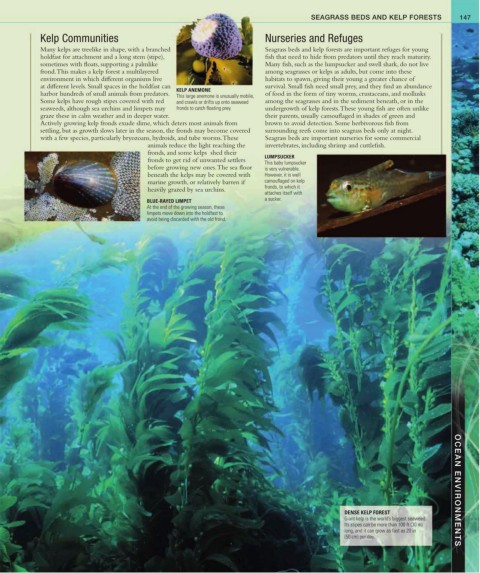
                                                                                                        DENSE KELP FOREST                OCEAN ENVIRONMENTS
                                                                                                        Giant kelp is the world’s biggest seaweed.
                                                                                                        Its stipes can be more than 100 ft (30 m)
                                                                                                        long, and it can grow as fast as 20 in
                                                                                                        (50 cm) per day.

