


Page 148 - (DK) Ocean - The Definitive Visual Guide
P. 148
146     SHALLOW SEAS


               Seagrass Beds and Kelp Forests


                                SEAGRASS BEDS AND KELP FORESTS are very different habitats, but           HUMAN IMPACT
                                   both are highly productive and contribute significantly to the         ENDANGERED
                                      total primary production of inshore waters. Seagrasses are the      GRAZERS
                                       only fully marine flowering plants. They thrive in shallow,
                                        sunlit water on sheltered, sandy seabeds, primarily in warm       Seagrasses are the primary food of
                                                                                                          green turtles, and the only food of
                                        water. Kelps are large brown seaweeds that grow as dense          manatees and dugongs. Globally,
                                          forests on rocks of the lower shore and subtidal zone,          these animals are now endangered
                                                                                                          or vulnerable, threatened by the
                                          preferring cold water. Both of these ecosystems have a          destruction of their feeding
                                                      complex structure and provide shelter for a         grounds. The coastal areas in
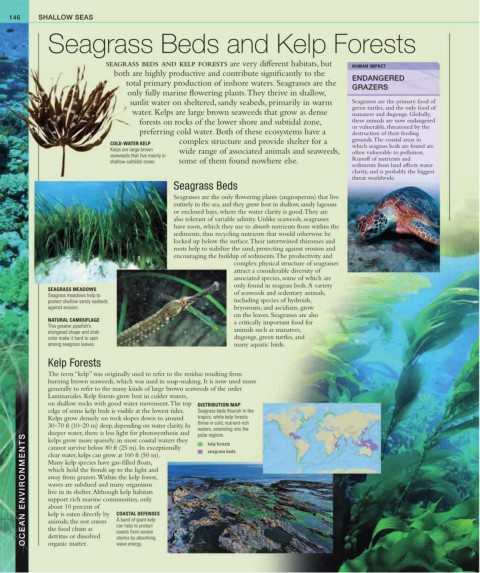
                                  COLD-WATER KELP                                                         which seagrass beds are found are
                                  Kelps are large brown   wide range of associated animals and seaweeds,   often vulnerable to pollution.
                                  seaweeds that live mainly in
                                  shallow subtidal zones.   some of them found nowhere else.              Runoff of nutrients and
                                                                                                          sediments from land affects water
                                                                                                          clarity, and is probably the biggest
                                                                                                          threat worldwide.
                                                     Seagrass Beds
                                                     Seagrasses are the only flowering plants (angiosperms) that live
                                                     entirely in the sea, and they grow best in shallow, sandy lagoons
                                                     or enclosed bays, where the water clarity is good. They are
                                                     also tolerant of variable salinity. Unlike seaweeds, seagrasses
                                                     have roots, which they use to absorb nutrients from within the
                                                     sediments, thus recycling nutrients that would otherwise be
                                                     locked up below the surface. Their intertwined rhizomes and
                                                     roots help to stabilize the sand, protecting against erosion and
                                                     encouraging the buildup of sediments. The productivity and
                                                                       complex physical structure of seagrasses
                                                                       attract a considerable diversity of
                                                                       associated species, some of which are
                                                                       only found in seagrass beds. A variety
               SEAGRASS MEADOWS
               Seagrass meadows help to                                of seaweeds and sedentary animals,
               protect shallow sandy seabeds                           including species of hydroids,
               against erosion.                                        bryozoans, and ascidians, grow
                                                                       on the leaves. Seagrasses are also
               NATURAL CAMOUFLAGE                                      a critically important food for
               This greater pipefish’s
               elongated shape and drab                                animals such as manatees,
               color make it hard to spot                              dugongs, green turtles, and
               among seagrass leaves.                                  many aquatic birds.

               Kelp Forests
               The term “kelp” was originally used to refer to the residue resulting from
               burning brown seaweeds, which was used in soap-making. It is now used more
               generally to refer to the many kinds of large brown seaweeds of the order
               Laminariales. Kelp forests grow best in colder waters,
               on shallow rocks with good water movement. The top  DISTRIBUTION MAP
               edge of some kelp beds is visible at the lowest tides.   Seagrass beds flourish in the
               Kelps grow densely on rock slopes down to around   tropics, while kelp forests
               30–70 ft (10–20 m) deep, depending on water clarity. In   thrive in cold, nutrient-rich
                                                            waters, extending into the
               deeper water, there is less light for photosynthesis and   polar regions.
        OCEAN ENVIRONMENTS  Many kelp species have gas-filled floats,
               kelps grow more sparsely; in most coastal waters they
                                                               kelp forests
               cannot survive below 80 ft (25 m). In exceptionally
                                                               seagrass beds
               clear water, kelps can grow at 160 ft (50 m).
               which hold the fronds up to the light and
               away from grazers. Within the kelp forest,
               waves are subdued and many organisms
               live in its shelter. Although kelp habitats
               support rich marine communities, only
               about 10 percent of
               kelp is eaten directly by
                                    COASTAL DEFENSES
                                    A band of giant kelp
               animals; the rest enters
                                    can help to protect
               the food chain as
                                    coasts from severe
               detritus or dissolved
                                    storms by absorbing
               organic matter.
                                    wave energy.

