


Page 178 - (DK) Ocean - The Definitive Visual Guide
P. 178
176     THE OPEN OCEAN AND OCEAN FLOOR


               The Continental Slope and Rise


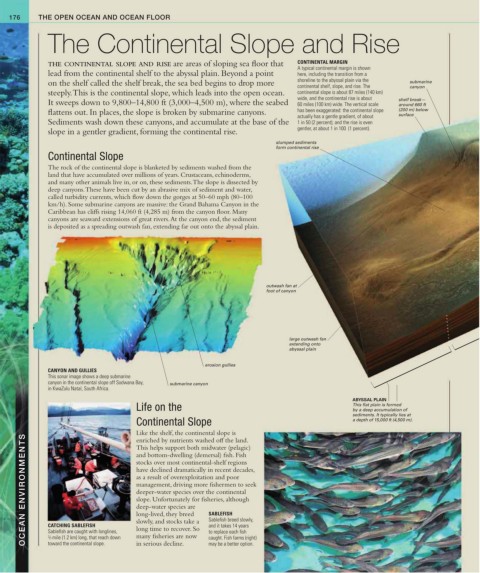
               THE CONTINENTAL SLOPE AND RISE are areas of sloping sea floor that         CONTINENTAL MARGIN
                                                                                          A typical continental margin is shown
               lead from the continental shelf to the abyssal plain. Beyond a point       here, including the transition from a
               on the shelf called the shelf break, the sea bed begins to drop more       shoreline to the abyssal plain via the   submarine
                                                                                          continental shelf, slope, and rise. The   canyon
               steeply. This is the continental slope, which leads into the open ocean.   continental slope is about 87 miles (140 km)
                                                                                          wide, and the continental rise is about    shelf break—
               It sweeps down to 9,800–14,800 ft (3,000–4,500 m), where the seabed        60 miles (100 km) wide. The vertical scale    around 660 ft
               flattens out. In places, the slope is broken by submarine canyons.         has been exaggerated: the continental slope   (200 m) below
                                                                                          actually has a gentle gradient, of about    surface
               Sediments wash down these canyons, and accumulate at the base of the       1 in 50 (2 percent); and the rise is even
                                                                                          gentler, at about 1 in 100  (1 percent).
               slope in a gentler gradient, forming the continental rise.
                                                                                   slumped sediments
                                                                                   form continental rise
               Continental Slope

               The rock of the continental slope is blanketed by sediments washed from the
               land that have accumulated over millions of years. Crustaceans, echinoderms,
               and many other animals live in, or on, these sediments. The slope is dissected by
               deep canyons. These have been cut by an abrasive mix of sediment and water,
               called turbidity currents, which flow down the gorges at 50–60 mph (80–100
               km/h). Some submarine canyons are massive: the Grand Bahama Canyon in the
               Caribbean has cliffs rising 14,060 ft (4,285 m) from the canyon floor. Many
               canyons are seaward extensions of great rivers. At the canyon end, the sediment
               is deposited as a spreading outwash fan, extending far out onto the abyssal plain.


                                                                                outwash fan at
                                                                                foot of canyon


                                                                                       large outwash fan
                                                                                       extending onto
                                                                                       abyssal plain

                                                              erosion gullies
               CANYON AND GULLIES
               This sonar image shows a deep submarine
               canyon in the continental slope off Sodwana Bay,   submarine canyon
               in KwaZulu Natal, South Africa.

                                                                                                          ABYSSAL PLAIN
                                         Life on the                                                      This flat plain is formed
                                                                                                          by a deep accumulation of
                                                                                                          sediments. It typically lies at
                                         Continental Slope                                                a depth of 15,000 ft (4,500 m).
                                         Like the shelf, the continental slope is
        OCEAN ENVIRONMENTS  CATCHING SABLEFISH   stocks over most continental-shelf regions
                                         enriched by nutrients washed off the land.
                                         This helps support both midwater (pelagic)
                                         and bottom-dwelling (demersal) fish. Fish

                                         have declined dramatically in recent decades,
                                         as a result of overexploitation and poor
                                         management, driving more fishermen to seek
                                         deeper-water species over the continental
                                         slope. Unfortunately for fisheries, although
                                         deep-water species are
                                         long-lived, they breed
                                                               SABLEFISH
                                                               Sablefish breed slowly,
                                         slowly, and stocks take a
                                                               and it takes 14 years
                                         long time to recover. So
               Sablefish are caught with longlines,
                                                               to replace each fish
                                         many fisheries are now
               2 / 3 mile (1.2 km) long, that reach down
                                                               caught. Fish farms (right)
                                         in serious decline.
                                                               may be a better option.
               toward the continental slope.

