


Page 179 - (DK) Ocean - The Definitive Visual Guide
P. 179
THE CONTINENTAL SLOPE AND RISE             177


                                  submarine canyon   some sediments
                      past shoreline   extends from shelf   deposited as delta
                      formed by   to abyssal plain  at river mouth
                      higher sea
                      level in past                                     material from
                                                                        uplands is
                                                                        gradually
                                                         sediments
            present                                      carried down    eroded and
            shoreline                                                   washed into
                                                         river to sea
                                                                        rivers


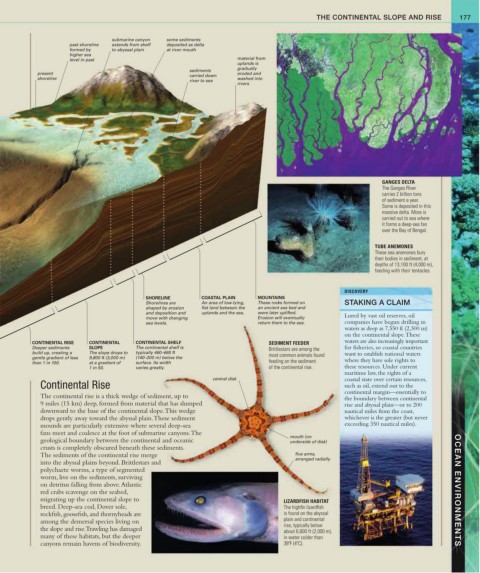
                                                                                                                   GANGES DELTA
                                                                                                                   The Ganges River
                                                                                                                   carries 2 billion tons
                                                                                                                   of sediment a year.
                                                                                                                   Some is deposited in this
                                                                                                                   massive delta. More is
                                                                                                                   carried out to sea where
                                                                                                                   it forms a deep-sea fan
                                                                                                                   over the Bay of Bengal.


                                                                                                                 TUBE ANEMONES
                                                                                                                 These sea anemones bury
                                                                                                                 their bodies in sediment, at
                                                                                                                 depths of 13,100 ft (4,000 m),
                                                                                                                 feeding with their tentacles.


                                                                                                        DISCOVERY
                                                             COASTAL PLAIN    MOUNTAINS
                                            SHORELINE
                                            Shorelines are    An area of low-lying,   These rocks formed on   STAKING A CLAIM
                                            shaped by erosion   flat land between the   an ancient sea bed and
                                            and deposition and   uplands and the sea.  were later uplifted.
                                            move with changing                Erosion will eventually   Lured by vast oil reserves, oil
                                            sea levels.                       return them to the sea.   companies have begun drilling in
                                                                                                        waters as deep as 7,550 ft (2,300 m)
                                                                                                        on the continental slope. These
                                                                                 SEDIMENT FEEDER        waters are also increasingly important
          CONTINENTAL RISE  CONTINENTAL   CONTINENTAL SHELF
          Deeper sediments   SLOPE       The continental shelf is                Brittlestars are among the    for fisheries, so coastal countries
          build up, creating a   The slope drops to   typically 460–660 ft       most common animals found   want to establish national waters
          gentle gradient of less   9,800 ft (3,000 m)   (140–200 m) below the                          where they have sole rights to
          than 1 in 100.   at a gradient of    surface. Its width                feeding on the sediment
                           1 in 50.      varies greatly.                         of the continental rise.  these resources. Under current
                                                                                                        maritime law, the rights of a
                                                                central disk                            coastal state over certain resources,
             Continental Rise                                                                           such as oil, extend out to the
                                                                                                        continental margin —essentially to
             The continental rise is a thick wedge of sediment, up to                                   the boundary between continental
             9 miles (15 km) deep, formed from material that has slumped                                rise and abyssal plain—or to 200
             downward to the base of the continental slope. This wedge                                  nautical miles from the coast,
             drops gently away toward the abyssal plain. These sediment                                 whichever is the greater (but never
             mounds are particularly extensive where several deep-sea                                   exceeding 350 nautical miles).
             fans meet and coalesce at the foot of submarine canyons. The
                                                                                       mouth (on
             geological boundary between the continental and oceanic                   underside of disk)
             crusts is completely obscured beneath these sediments.
             The sediments of the continental rise merge                                 five arms,
                                                                                         arranged radially
             into the abyssal plains beyond. Brittlestars and
             polychaete worms, a type of segmented
             worm, live on the sediments, surviving
             on detritus falling from above. Atlantic
             red crabs scavenge on the seabed,                                                                                           OCEAN ENVIRONMENTS
             migrating up the continental slope to                                   LIZARDFISH HABITAT
             breed. Deep-sea cod, Dover sole,                                        The highfin lizardfish
             rockfish, goosefish, and thornyheads are                                is found on the abyssal
             among the demersal species living on                                    plain and continental
                                                                                     rise, typically below
             the slope and rise. Trawling has damaged
                                                                                     about 6,600 ft (2,000 m),
             many of these habitats, but the deeper                                  in water colder than
             canyons remain havens of biodiversity.                                  39ºF (4ºC).

