


Page 181 - (DK) Ocean - The Definitive Visual Guide
P. 181
179


                                     Cold-water Reefs


                                     Deep-sea corals were first discovered in 1869, but it
                                                                                         LIFE IN COLD WATER
                                     took the advent of sonar and deep-sea submersibles to
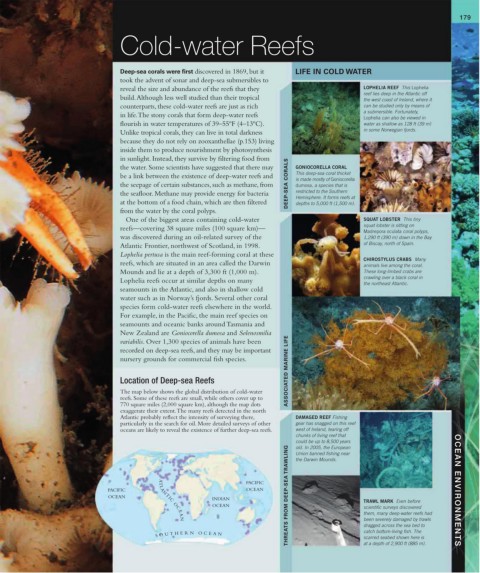
                                     reveal the size and abundance of the reefs that they                    LOPHELIA REEF  This Lophelia
                                                                                                             reef lies deep in the Atlantic off
                                     build. Although less well studied than their tropical                   the west coast of Ireland, where it
                                     counterparts, these cold-water reefs are just as rich                   can be studied only by means of
                                                                                                             a submersible. Fortunately,
                                     in life. The stony corals that form deep-water reefs
                                                                                                             Lophelia can also be viewed in
                                     flourish in water temperatures of 39–55ºF (4–13ºC).                     water as shallow as 128 ft (39 m)
                                                                                                             in some Norwegian fjords.
                                     Unlike tropical corals, they can live in total darkness
                                     because they do not rely on zooxanthellae (p.153) living
                                     inside them to produce nourishment by photosynthesis
                                     in sunlight. Instead, they survive by filtering food from
                                     the water. Some scientists have suggested that there may   GONIOCORELLA CORAL
                                     be a link between the existence of deep-water reefs and   This deep-sea coral thicket
                                                                                         is made mostly of Goniocorella
                                     the seepage of certain substances, such as methane, from   DEEP-SEA CORALS  dumosa, a species that is
                                     the seafloor. Methane may provide energy for bacteria   restricted to the Southern
                                                                                         Hemisphere. It forms reefs at
                                     at the bottom of a food chain, which are then filtered    depths to 5,000 ft (1,500 m).
                                     from the water by the coral polyps.
                                      One of the biggest areas containing cold-water                         SQUAT LOBSTER  This tiny
                                                                                                             squat lobster is sitting on
                                     reefs—covering 38 square miles (100 square km)—
                                                                                                             Madrepora oculata coral polyps,
                                     was discovered during an oil-related survey of the                      1,290 ft (390 m) down in the Bay
                                     Atlantic Frontier, northwest of Scotland, in 1998.                      of Biscay, north of Spain.
                                     Lophelia pertusa is the main reef-forming coral at these
                                                                                                             CHIROSTYLUS CRABS  Many
                                     reefs, which are situated in an area called the Darwin                  animals live among the coral.
                                     Mounds and lie at a depth of 3,300 ft (1,000 m).                        These long-limbed crabs are
                                                                                                             crawling over a black coral in
                                     Lophelia reefs occur at similar depths on many
                                                                                                             the northeast Atlantic.
                                     seamounts in the Atlantic, and also in shallow cold
                                     water such as in Norway’s fjords. Several other coral
                                     species form cold-water reefs elsewhere in the world.
                                     For example, in the Pacific, the main reef species on
                                     seamounts and oceanic banks around Tasmania and
                                     New Zealand are Goniocorella dumosa and Solenosmilia
                                     variabilis. Over 1,300 species of animals have been
                                     recorded on deep-sea reefs, and they may be important
                                     nursery grounds for commercial fish species.


                                     Location of Deep-sea Reefs                        ASSOCIATED MARINE LIFE
                                     The map below shows the global distribution of cold-water
                                     reefs. Some of these reefs are small, while others cover up to
                                     770 square miles (2,000 square km), although the map dots
                                     exaggerate their extent. The many reefs detected in the north
                                     Atlantic probably reflect the intensity of surveying there,   DAMAGED REEF Fishing
                                     particularly in the search for oil. More detailed surveys of other   gear has snagged on this reef
                                     oceans are likely to reveal the existence of further deep-sea reefs.  west of Ireland, tearing off
                                                                                         chunks of living reef that
                                                                                         could be up to 8,500 years
                                                                                       THREATS FROM DEEP-SEA TRAWLING
                                                                                         old. In 2005, the European
                                                                                         Union banned fishing near
                                                                                         the Darwin Mounds.


                                                                          PACIFIC
                                 PACIFIC                                  OCEAN                                                          OCEAN ENVIRONMENTS
                                 OCEAN
                                                                INDIAN                                       TRAWL MARK  Even before
                                                                OCEAN                                        scientific surveys discovered
                                                                                                             them, many deep-water reefs had
                                                                                                             been severely damaged by trawls
                                                ATLANTIC OCEAN
                                                                                                             catch bottom-living fish. The
                                               S O U T H E R N   O C E A N                                   dragged across the sea bed to
                                                                                                             scarred seabed shown here is
                                                                                                             at a depth of 2,900 ft (885 m).

