


Page 183 - (DK) Ocean - The Definitive Visual Guide
P. 183
181


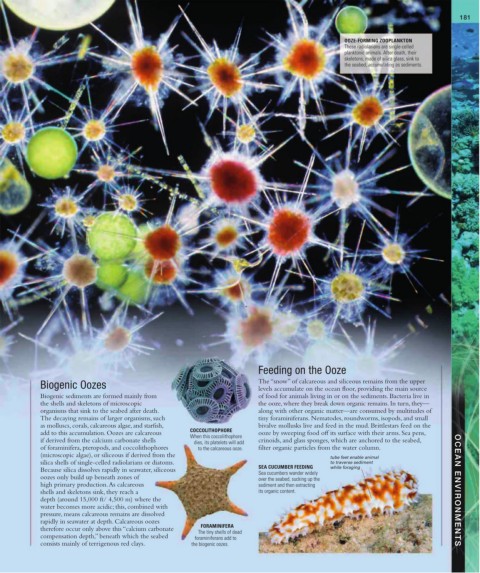
                                                                                                        OOZE-FORMING ZOOPLANKTON
                                                                                                        These radiolarians are single-celled
                                                                                                        planktonic animals. After death, their
                                                                                                        skeletons, made of silica glass, sink to
                                                                                                        the seabed, accumulating as sediments.


                                                                              Feeding on the Ooze

             Biogenic Oozes                                                   The “snow” of calcareous and siliceous remains from the upper
                                                                              levels accumulate on the ocean floor, providing the main source
             Biogenic sediments are formed mainly from                        of food for animals living in or on the sediments. Bacteria live in
             the shells and skeletons of microscopic                          the ooze, where they break down organic remains. In turn, they—
             organisms that sink to the seabed after death.                   along with other organic matter —are consumed by multitudes of
             The decaying remains of larger organisms, such                   tiny foraminiferans. Nematodes, roundworms, isopods, and small
             as molluscs, corals, calcareous algae, and starfish,             bivalve mollusks live and feed in the mud. Brittlestars feed on the
             add to this accumulation. Oozes are calcareous    COCCOLITHOPHORE  ooze by sweeping food off its surface with their arms. Sea pens,
                                                          When this coccolithophore
             if derived from the calcium carbonate shells    dies, its platelets will add    crinoids, and glass sponges, which are anchored to the seabed,
             of foraminifera, pteropods, and coccolithophores   to the calcareous ooze.   filter organic particles from the water column.
             (microscopic algae), or siliceous if derived from the                                 tube feet enable animal
             silica shells of single-celled radiolarians or diatoms.                               to traverse sediment
                                                                              SEA CUCUMBER FEEDING  while foraging
             Because silica dissolves rapidly in seawater, siliceous
                                                                              Sea cucumbers wander widely
             oozes only build up beneath zones of                             over the seabed, sucking up the
             high primary production. As calcareous                           sediment and then extracting
             shells and skeletons sink, they reach a                          its organic content.                                       OCEAN ENVIRONMENTS
             depth (around 15,000 ft/ 4,500 m) where the
             water becomes more acidic; this, combined with
             pressure, means calcareous remains are dissolved
             rapidly in seawater at depth. Calcareous oozes
                                                             FORAMINIFERA
             therefore occur only above this “calcium carbonate
                                                            The tiny shells of dead
             compensation depth,” beneath which the seabed   foraminiferans add to
             consists mainly of terrigenous red clays.     the biogenic oozes.

