


Page 182 - (DK) Ocean - The Definitive Visual Guide
P. 182
180     THE OPEN OCEAN AND OCEAN FLOOR


               Ocean Floor Sediments


               OVER VAST AREAS OF THE SEABED, THE UNDERLYING landforms are hidden beneath
               deep layers of sediments. Made up of silts, muds, or sands that have built up over
               200 million years, they now form a blanket that is several miles thick in places. The
               sediments have various origins. One group, terrigenous sediments, come from land,
               mainly from fragments of eroded rock that are carried down rivers into the sea, then
               down the continental slope to form the continental rise and abyssal plain beyond.
               Other sediments are biogenic, formed from the hard remains of dead animals and
               plants. A few, called authigenic sediments, are made up of chemicals precipitated
               from seawater. There are even cosmogenic sediments, which come from outer space
               as particles in space dust and meteors. All accumulate to form extensive, flat plains.
               Various animals feed here and burrow into the sediments for shelter.


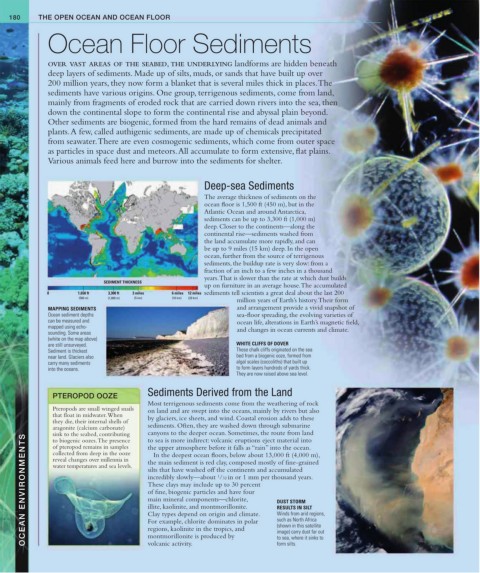
                                                              Deep-sea Sediments
                                                              The average thickness of sediments on the
                                                              ocean floor is 1,500 ft (450 m), but in the
                                                              Atlantic Ocean and around Antarctica,
                                                              sediments can be up to 3,300 ft (1,000 m)
                                                              deep. Closer to the continents —along the
                                                              continental rise—sediments washed from
                                                              the land accumulate more rapidly, and can
                                                              be up to 9 miles (15 km) deep. In the open
                                                              ocean, further from the source of terrigenous
                                                              sediments, the buildup rate is very slow: from a
                                                              fraction of an inch to a few inches in a thousand
                                                              years. That is slower than the rate at which dust builds
                                SEDIMENT THICKNESS
                                                              up on furniture in an average house. The accumulated
               0        1,650 ft  3,300 ft   3 miles  6 miles  12 miles  sediments tell scientists a great deal about the last 200
                        (500 m)  (1,000 m)  (5 km)  (10 km)  (20 km)
                                                                       million years of Earth’s history. Their form
               MAPPING SEDIMENTS                                       and arrangement provide a vivid snapshot of
               Ocean sediment depths                                   sea-floor spreading, the evolving varieties of
               can be measured and                                     ocean life, alterations in Earth’s magnetic field,
               mapped using echo-
               sounding. Some areas                                    and changes in ocean currents and climate.
               (white on the map above)
               are still unsurveyed.                                   WHITE CLIFFS OF DOVER
               Sediment is thickest                                    These chalk cliffs originated on the sea
               near land. Glaciers also                                bed from a biogenic ooze, formed from
               carry many sediments                                    algal scales (coccoliths) that built up
               into the oceans.                                        to form layers hundreds of yards thick.
                                                                       They are now raised above sea level.


                 PTEROPOD OOZE               Sediments Derived from the Land
                                             Most terrigenous sediments come from the weathering of rock
                 Pteropods are small winged snails   on land and are swept into the oceans, mainly by rivers but also
                 that float in midwater. When    by glaciers, ice sheets, and wind. Coastal erosion adds to these
                 they die, their internal shells of
                 aragonite (calcium carbonate)   sediments. Often, they are washed down through submarine
                 sink to the seabed, contributing   canyons to the deeper ocean. Sometimes, the route from land
        OCEAN ENVIRONMENTS  water temperatures and sea levels.    the main sediment is red clay, composed mostly of fine-grained
                                             to sea is more indirect: volcanic eruptions eject material into
                 to biogenic oozes. The presence
                 of pteropod remains in samples
                                             the upper atmosphere before it falls as “rain” into the ocean.
                 collected from deep in the ooze
                                               In the deepest ocean floors, below about 13,000 ft (4,000 m),
                 reveal changes over millennia in
                                             silts that have washed off the continents and accumulated

                                                                  1
                                             incredibly slowly—about  /32 in or 1 mm per thousand years.
                                             These clays may include up to 30 percent
                                             of fine, biogenic particles and have four
                                             main mineral components —chlorite,
                                                                                   DUST STORM
                                             illite, kaolinite, and montmorillonite.
                                                                                   RESULTS IN SILT
                                             Clay types depend on origin and climate.
                                                                                   Winds from arid regions,
                                                                                   such as North Africa
                                             For example, chlorite dominates in polar
                                                                                   (shown in this satellite
                                             regions, kaolinite in the tropics, and
                                                                                   image) carry dust far out
                                             montmorillonite is produced by
                                                                                   to sea, where it sinks to
                                             volcanic activity.
                                                                                   form silts.

