


Page 190 - (DK) Ocean - The Definitive Visual Guide
P. 190
188     THE OPEN OCEAN AND OCEAN FLOOR


               Vents and Seeps


               HYDROTHERMAL VENTS ARE SIMILAR to hot springs                DISCOVERY
               on land. Located near ocean ridges and rifts, at an          DISCOVERING WHITE SMOKERS
               average depth of 7,000 ft (2,100 m), they spew out
               mineral-rich, superheated seawater. Some have tall           The first hydrothermal vents
                                                                            that scientists observed from
               chimneys, formed from dissolved minerals that                Alvin, a submersible, in 1977,
               precipitate when the hot vent water meets cold, deep-        were black smokers. Scientists
                                                                            then explored other sites near
               ocean water. The mix of heat and chemicals supports          mid-ocean ridges and found
               animal communities around the vents—the first life           more vent systems. Some looked
                                                                            different: their fluids were white,
               known to exist entirely without the energy of sunlight.      cooler, and emerged more slowly
                                                                            from shorter chimneys. These were
               Elsewhere, slower, cooler emissions of chemicals called
                                                                            called white smokers (see right).
               hydrocarbons occur from sites known as cold seeps.


                                                          Hydrothermal Vents
                                                          Hydrothermal vents always form close to mid-ocean ridges
                                                          and rifts (see p.185), where new ocean crust is forming and
                                                          spreading, and where magma from the Earth’s mantle lies
                                                          relatively close to the surface. Seawater seeps into rock
                                                          cracks opened up by the spreading sea floor. It penetrates
                                                          several miles into the newly formed crust, close to the
                                                          hot magma below. This heats the water to 660–750ºF
                                                          (350–400ºC). The high pressure at these depths stops it
                                                          from boiling, and it becomes superheated, dissolving
                                                          minerals from the rocks that it is passing through, including
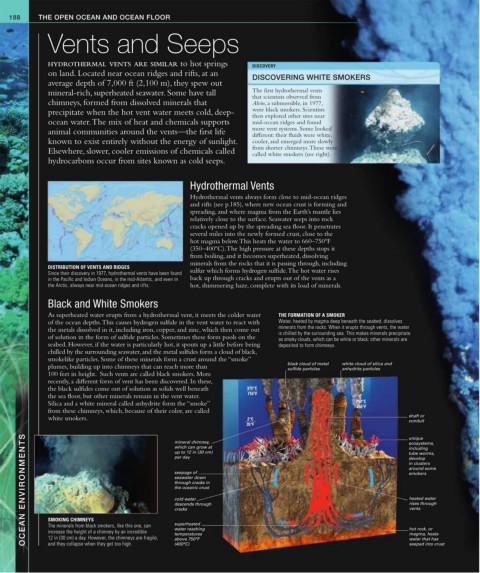
               DISTRIBUTION OF VENTS AND RIDGES
               Since their discovery in 1977, hydrothermal vents have been found   sulfur which forms hydrogen sulfide. The hot water rises
               in the Pacific and Indian Oceans, in the mid-Atlantic, and even in   back up through cracks and erupts out of the vents as a
               the Arctic, always near mid-ocean ridges and rifts.       hot, shimmering haze, complete with its load of minerals.

               Black and White Smokers
               As superheated water erupts from a hydrothermal vent, it meets the colder water   THE FORMATION OF A SMOKER
               of the ocean depths. This causes hydrogen sulfide in the vent water to react with   Water, heated by magma deep beneath the seabed, dissolves
               the metals dissolved in it, including iron, copper, and zinc, which then come out   minerals from the rocks. When it erupts through vents, the water
                                                                                    is chilled by the surrounding sea. This makes minerals precipitate
               of solution in the form of sulfide particles. Sometimes these form pools on the    as smoky clouds, which can be white or black; other minerals are
               seabed. However, if the water is particularly hot, it spouts up a little before being   deposited to form chimneys.
               chilled by the surrounding seawater, and the metal sulfides form a cloud of black,
               smokelike particles. Some of these minerals form a crust around the “smoke”
                                                                                       black cloud of metal   white cloud of silica and
               plumes, building up into chimneys that can reach more than              sulfide particles    anhydrite particles
               100 feet in height.  Such vents are called black smokers. More
               recently, a different form of vent has been discovered. In these,
               the black sulfides come out of solution as solids well beneath   375°C
               the sea floor, but other minerals remain in the vent water.   710°F
               Silica and a white mineral called anhydrite form the “smoke”                                250°C
                                                                                                           480°F
               from these chimneys, which, because of their color, are called
               white smokers.                                              2°C                                             shaft or
                                                                                                                           conduit
                                                                          35°F                                             unique
        OCEAN ENVIRONMENTS  SMOKING CHIMNEYS         seepage of                                                            develop
                                                     mineral chimney,
                                                                                                                           ecosystems,
                                                     which can grow at
                                                                                                                           including
                                                     up to 12 in (30 cm)
                                                                                                                           tube worms,
                                                     per day
                                                                                                                           in clusters
                                                                                                                           around some
                                                                                                                           smokers
                                                     seawater down
                                                     through cracks in
                                                     the oceanic crust
                                                                                                                           heated water
                                                     cold water
                                                                                                                           rises through
                                                     descends through
                                                                                                                           vents
                                                     cracks
                                                     superheated
               The minerals from black smokers, like this one, can
                                                                                                                           hot rock, or
                                                     water reaching
               increase the height of a chimney by an incredible
                                                     temperatures
                                                                                                                           magma, heats
               12 in (30 cm) a day. However, the chimneys are fragile,
                                                     above 750°F
                                                                                                                           water that has
               and they collapse when they get too high.
                                                                                                                           seeped into crust
                                                     (400°C)

