


Page 195 - (DK) Ocean - The Definitive Visual Guide
P. 195
ICE SHELVES        193


             Surface and Interior                                       Beneath the Ice Shelves

             The upper surfaces of Antarctic ice shelves are inhospitable places. For   Underneath the Antarctic ice shelves are extensive bodies
             most of the year, cold air streams called katabatic winds blow down   of water that are some of the least explored regions
             from the Antarctic Ice Sheet and over the ice shelves. The surface of   on Earth. Seawater is thought to circulate
             the ice is not flat, but is shaped by the winds into a series of ridges and   constantly here, caused partly by new ice
                                         troughs, called sastrugi. These are   formation underneath and around the
                                         typically covered in a snow blanket.   ice shelves. As new ice forms, it “rejects”
                                         In some areas, the surface is littered   salt, making the surrounding seawater
                                         with rocks from the input glacier or   denser. This causes the seawater to sink, and
                                         glaciers, or even with material that   helps drive the circulation. Recent attempts
                                         has been carried upward from the   have been made to explore these areas, using
                                         sea floor by vertical movement. In   robotic submarines to take measurements.
                                         summer, small ponds form on some   Little is known about the organisms that
                                         ice shelves and provide a home for   live here, although in 2005 a community   LIFE UNDER THE ICE
                                                                                                            Organisms such as starfish and
                                         various types of microscopic   of clams and bacterial mats was found on   worms live in shallow water
                                         organisms. Internally, an ice shelf   the sea floor under the Larsen B Ice Shelf   around the edge of Antarctica,
                                         usually contains some tide-induced   after it broke up (see p.487).  and possibly under the ice shelves.
                                         cracks and crevasses.                                              melting zone
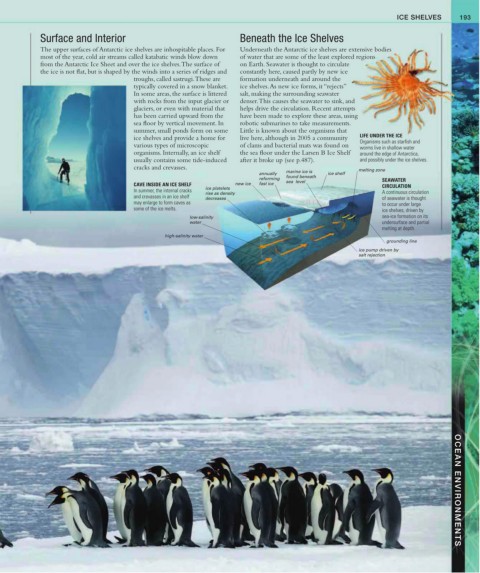
                                                                                      marine ice is
                                                                              annually             ice shelf
                                                                              reforming   found beneath            SEAWATER
                                         CAVE INSIDE AN ICE SHELF      new ice  fast ice  sea  level               CIRCULATION
                                         In summer, the internal cracks   ice platelets                            A continuous circulation
                                                              rise as density
                                         and crevasses in an ice shelf    decreases                                of seawater is thought
                                         may enlarge to form caves as                                              to occur under large
                                         some of the ice melts.                                                    ice shelves, driven by
                                                         low-salinity                                              sea-ice formation on its
                                                         water                                                     undersurface and partial
                                                                                                                   melting at depth.
                                                  high-salinity water
                                                                                                                    grounding line
                                                                                                            ice pump driven by
                                                                                                            salt rejection               OCEAN ENVIRONMENTS

