


Page 187 - (DK) Ocean - The Definitive Visual Guide
P. 187
ABYSSAL PLAINS, TRENCHES, AND MID-OCEAN RIDGES 185
Mid–ocean Ridges
New sea bed is produced wherever tectonic plates diverge. As plates move
apart, they create a rift. Magma wells up through this rift from the Earth’s
mantle, forming volcanoes and creating an underwater mountain chain,
called a mid-ocean ridge. The lava cools as it meets the seawater, and
solidifies in vertical basalt dikes or fields of pillow lava (see p.42).
Mid-ocean ridges are assembly lines along which new ocean floor is
being produced. The ridges and lava fields remain visible for some time
before sediments accumulate over them. Sometimes the volcanoes extend
above sea level, producing islands such as Iceland. Some mid-ocean ridges
spread slowly, allowing deep rift valleys to form down their centers—
others are much faster-spreading but lack rift
valleys. Sometimes the ridges are disrupted
sideways by transform faults.
As the new sea bed spreads outward,
tensions are created, making it crack. Water
seeps into these cracks and reemerges from
PILLOW LAVA hydrothermal vents (see p.188). The oceanic
Under the high pressure of ridge system is the third largest feature on the
the deep ocean, lava oozes
slowly from the mid-ocean Earth’s surface, after the oceans and continents.
crests. When it meets cold
seawater, it cools rapidly to
form globular masses, called ASCENSION ISLAND
pillow lavas due to their Ascension Island arises where the Mid-Atlantic
shape. About 1.4 square Ridge protrudes above sea level in the south
miles (3.5 square km) of new Atlantic. It covers 35 square miles (90 square km)
sea floor is formed each year and ascends to 2,817 ft (859 m) on Green Mountain.
along mid-ocean ridges. Sooty terns and sea turtles breed around its shores.
OCEAN WANDERERS Ridges of the World
Macquarie Island, on the Macquarie
Ridge, provides a nesting site for the The longest mid-ocean ridge occurs where the Eurasian and
black-browed albatross. African plates are diverging from the North and South American
Outside of the breeding plates. The Mid-Atlantic Ridge runs along this boundary for
season, it wanders the
Southern Ocean. 10,000 miles (16,000 km), from the Arctic Ocean to beyond the
southern tip of Africa, rising 6,000–13,000 ft (2,000–4,000 m)
above the sea floor.
A chain of volcanoes runs down its length, most famously in
Iceland. An eruption close to Iceland in 1963 created a new volcanic
island, Surtsey. Ascension Island lies very close to the ridge, and the
Azores straddle it, while St. Helena and Tristan da Cunha arise from
isolated volcanoes, displaced from it. A valley, 15 miles (25 km) wide,
extends along the ridge crest. In the Pacific the main ridge system
is the East Pacific Rise. This is Earth’s fastest-spreading system,
separating at 5–6 in (13–16 cm) per year. A series of mid-ocean
ridges encircle Antarctica, along the divergent boundaries between
the Antarctic Plate and its neighbors, and the Carlsberg Ridge runs
down the center of the Indian Ocean.
Mid-Atlantic Ridge
with eastern section -42˚ -41˚
displaced by fault in
southern part of map
-40˚
Atlantis 31˚ 31˚
fracture zone -43˚
-44˚
30˚ 30˚
Atlantis
transform
fault
30˚ 30˚ N
-41˚ OCEAN ENVIRONMENTS
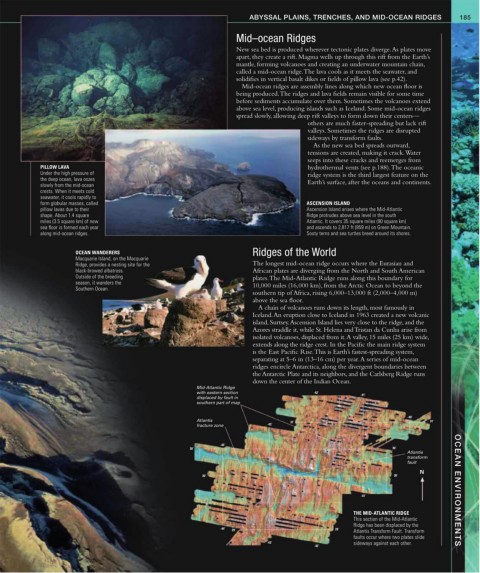
THE MID-ATLANTIC RIDGE
This section of the Mid-Atlantic
Ridge has been displaced by the
-44˚ 29˚
29˚ Atlantis Transform Fault. Transform
faults occur where two plates slide
-43˚ sideways against each other.
-42˚

