


Page 191 - (DK) Ocean - The Definitive Visual Guide
P. 191
VENTS AND SEEPS          189


                                                                                 Life Without Sunlight

                                                                                  The first biologists to explore hydrothermal vents were
                                                                                     amazed at the life they saw. Masses of limpets, shrimps,
                                                                                       sea anemones, and tube worms cluster close to the
                                                                                       vents, beside unusually large clams and mussels. White
                                                                                       crabs and a few fish, such as the eelpout, scrabble
                                                                                       among them. Not every vent system is the same:
                                                                                       in the Atlantic, there are no tube worms, clams, or
                                                                                       mussels, but lots of white shrimps. Some animals that
                                                                                       live in darkness depend on sunlit waters for their food
                                                                                      supply but vent animals are remarkable in that they
                                                                                     do not need sunlight for energy. White mats of bacteria
                                                                                     around vents are the key. They oxidize sulfides from the
                                                                                                        vent water to make energy, and
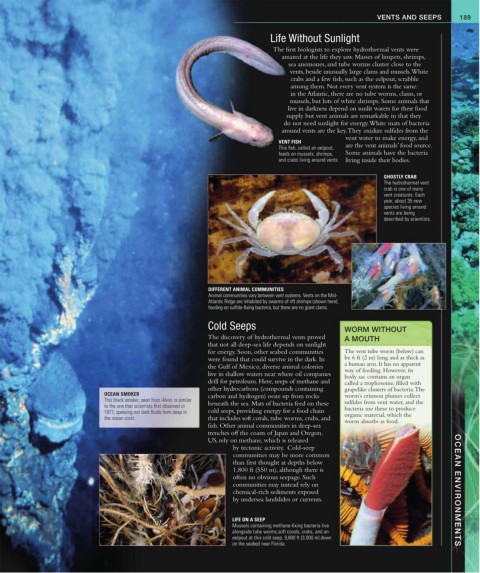
                                                                                    VENT FISH
                                                                                    This fish, called an eelpout,   are the vent animals’ food source.
                                                                                    feeds on mussels, shrimps,    Some animals have the bacteria
                                                                                    and crabs living around vents.    living inside their bodies.

                                                                                                                   GHOSTLY CRAB
                                                                                                                   The hydrothermal vent
                                                                                                                   crab is one of many
                                                                                                                   vent creatures. Each
                                                                                                                   year, about 35 new
                                                                                                                   species living around
                                                                                                                   vents are being
                                                                                                                   described by scientists.


                                                               DIFFERENT ANIMAL COMMUNITIES
                                                               Animal communities vary between vent systems. Vents on the Mid-
                                                               Atlantic Ridge are inhabited by swarms of rift shrimps (shown here),
                                                               feeding on sulfide-fixing bacteria, but there are no giant clams.

                                                               Cold Seeps                               WORM WITHOUT
                                                               The discovery of hydrothermal vents proved   A MOUTH
                                                               that not all deep-sea life depends on sunlight
                                                               for energy. Soon, other seabed communities   The vent tube worm (below) can
                                                               were found that could survive in the dark. In   be 6 ft (2 m) long and as thick as
                                                               the Gulf of Mexico, diverse animal colonies   a human arm. It has no apparent
                                                                                                        way of feeding. However, its
                                                               live in shallow waters near where oil companies   body sac contains an organ
                                                               drill for petroleum. Here, seeps of methane and   called a trophosome, filled with
                                                               other hydrocarbons (compounds containing   grapelike clusters of bacteria. The
                                OCEAN SMOKER                   carbon and hydrogen) ooze up from rocks   worm’s crimson plumes collect
                                This black smoker, seen from Alvin, is similar                          sulfides from vent water, and the
                                to the one that scientists first observed in   beneath the sea. Mats of bacteria feed on these   bacteria use these to produce
                                1977, spewing out dark fluids from deep in    cold seeps, providing energy for a food chain
                                the ocean crust.               that includes soft corals, tube worms, crabs, and   organic material, which the
                                                                                                        worm absorbs as food.
                                                               fish. Other animal communities in deep-sea
                                                               trenches off the coasts of Japan and Oregon,
                                                               US, rely on methane, which is released
                                                                      by tectonic activity.  Cold-seep
                                                                      communities may be more common
                                                                      than first thought at depths below
                                                                      1,800 ft (550 m), although there is
                                                                      often no obvious seepage. Such
                                                                      communities may instead rely on
                                                                      chemical-rich sediments exposed                                    OCEAN ENVIRONMENTS
                                                                      by undersea landslides or currents.


                                                                      LIFE ON A SEEP
                                                                      Mussels containing methane-fixing bacteria live
                                                                      alongside tube worms,soft corals, crabs, and an
                                                                      eelpout at this cold seep, 9,800 ft (3,000 m) down
                                                                      on the seabed near Florida.

