


Page 193 - (DK) Ocean - The Definitive Visual Guide
P. 193
THE TWO POLAR OCEANS are the Arctic
                                                                                               Ocean in the Northern Hemisphere and the

                                                                                               Southern Ocean, which surrounds the

                                                                                               continent of Antarctica, in the Southern
                                                                                               Hemisphere. They differ from other oceans

                                                                                               in several respects, not least in the sheer

                                                                                               quantity of ice that floats on them. This

                                                                                               includes sea ice, which is frozen seawater,

                                                                                               and icebergs and ice shelves, which are
                                                                                               frozen fresh water. The polar oceans contain

                                                                                               fewer temperature layers than other

                                                                                               oceans, being uniformly cold, and they have
                                                                                               different circulation patterns, which are

                                                                                               partly wind-driven but also influenced by

                                                                                               such factors as river inflow (in the Arctic

                                                                                               Ocean) and sea-ice formation. The edges of

                                                                                               the sea ice are biologically productive zones
                                                                                               where plankton blooms occur in summer,

                                                                                               attracting many fish, birds, and mammals.


                                                                                           POLAR OCEANS


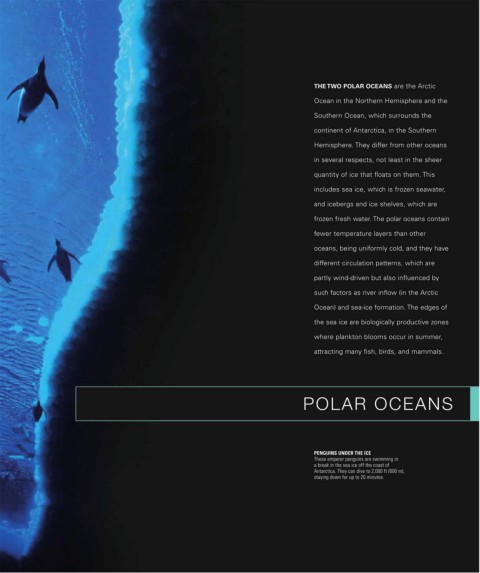
                                                                                               PENGUINS UNDER THE ICE
                                                                                               These emperor penguins are swimming in
                                                                                               a break in the sea ice off the coast of
                                                                                               Antarctica. They can dive to 2,000 ft (600 m),
                                                                                               staying down for up to 20 minutes.

