


Page 186 - (DK) Ocean - The Definitive Visual Guide
P. 186
184     THE OPEN OCEAN AND OCEAN FLOOR


               The Ring of Fire                                             SAFE HAVEN

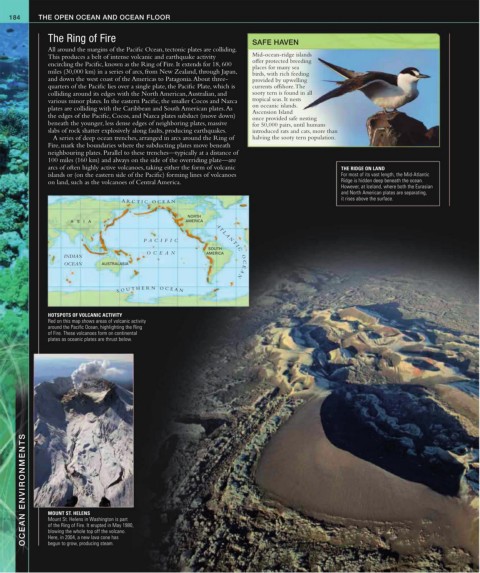
               All around the margins of the Pacific Ocean, tectonic plates are colliding.
               This produces a belt of intense volcanic and earthquake activity   Mid-ocean-ridge islands
               encircling the Pacific, known as the Ring of Fire. It extends for 18, 600   offer protected breeding
                                                                            places for many sea
               miles (30,000 km) in a series of arcs, from New Zealand, through Japan,   birds, with rich feeding
               and down the west coast of the Americas to Patagonia. About three-  provided by upwelling
               quarters of the Pacific lies over a single plate, the Pacific Plate, which is   currents offshore. The
               colliding around its edges with the North American, Australian, and   sooty tern is found in all
               various minor plates. In the eastern Pacific, the smaller Cocos and Nazca   tropical seas. It nests
               plates are colliding with the Caribbean and South American plates. As   on oceanic islands.
                                                                            Ascension Island
               the edges of the Pacific, Cocos, and Nazca plates subduct (move down)   once provided safe nesting
               beneath the younger, less dense edges of neighboring plates, massive   for 50,000 pairs, until humans
               slabs of rock shatter explosively along faults, producing earthquakes.   introduced rats and cats, more than
                  A series of deep ocean trenches, arranged in arcs around the Ring of   halving the sooty tern population.
               Fire, mark the boundaries where the subducting plates move beneath
               neighbouring plates. Parallel to these trenches—typically at a distance of
               100 miles (160 km) and always on the side of the overriding plate—are
               arcs of often highly active volcanoes, taking either the form of volcanic               THE RIDGE ON LAND
               islands or (on the eastern side of the Pacific) forming lines of volcanoes              For most of its vast length, the Mid-Atlantic
               on land, such as the volcanoes of Central America.                                      Ridge is hidden deep beneath the ocean.
                                                                                                       However, at Iceland, where both the Eurasian
                                                                                                       and North American plates are separating,
                                                                                                       it rises above the surface.
                                     A R C T I C   O C E A N

                                                         NORTH
                      A SIA                             AMERICA

                                            P A CIFIC            A T L A N T I C
                                                               SOUTH
                                             OCEAN            AMERICA
                    INDIAN                                               O
                    OCEAN      AUSTRALASIA                               A N  C
                                                                         E


                                     S O U T H E R N   O C E A N


               HOTSPOTS OF VOLCANIC ACTIVITY
               Red on this map shows areas of volcanic activity
               around the Pacific Ocean, highlighting the Ring
               of Fire. These volcanoes form on continental
               plates as oceanic plates are thrust below.


        OCEAN ENVIRONMENTS  MOUNT ST. HELENS


               Mount St. Helens in Washington is part
               of the Ring of Fire. It erupted in May 1980,
               blowing the whole top off the volcano.
               Here, in 2004, a new lava cone has
               begun to grow, producing steam.

