


Page 196 - (DK) Ocean - The Definitive Visual Guide
P. 196
194     POLAR OCEANS


               Icebergs


               ICEBERGS ARE HUGE, FLOATING chunks of ice                                    Iceberg Properties
               that have broken off, or been calved, from the
                                                                                            Icebergs consist principally of frozen fresh water,
               edges of large glaciers and ice shelves. These
                                                                                            with no salt content. This is because they originate
               chunks range from car-sized objects to                                       not from seawater but from glaciers or ice shelves
               vast slabs of ice that are bigger than some                                  (floating glaciers), and glaciers themselves come
                                                                                            from compacted snow.  Typically, an iceberg has
               countries. It is estimated that each year 40,000
                                                                                            a temperature of about -4 to 5˚F (-15 to -20˚C)
               to 50,000 substantial icebergs are calved from                               at its core and 32˚F (0˚C) at its surface. In addition
               the glaciers of Greenland. A smaller number                                  to ice, some icebergs contain rock debris. This
                                                                                            is material that has fallen onto the parent glacier
               of gigantic icebergs break off the ice shelves
                                                                                            from surrounding mountains, or frozen to
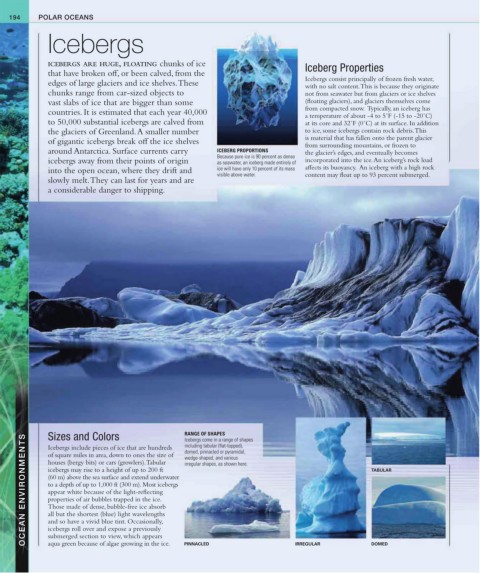
               around Antarctica. Surface currents carry          ICEBERG PROPORTIONS       the glacier’s edges, and eventually becomes
                                                                  Because pure ice is 90 percent as dense
               icebergs away from their points of origin          as seawater, an iceberg made entirely of   incorporated into the ice. An iceberg’s rock load
               into the open ocean, where they drift and          ice will have only 10 percent of its mass   affects its buoyancy.  An iceberg with a high rock
                                                                  visible above water.      content may float up to 93 percent submerged.
               slowly melt. They can last for years and are
               a considerable danger to shipping.


                                                        RANGE OF SHAPES
        OCEAN ENVIRONMENTS  Sizes and Colors            PINNACLED                        IRREGULAR              TABULAR
                                                        Icebergs come in a range of shapes
                                                        including tabular (flat-topped),
               Icebergs include pieces of ice that are hundreds
                                                        domed, pinnacled or pyramidal,
               of square miles in area, down to ones the size of
                                                        wedge-shaped, and various
               houses (bergy bits) or cars (growlers). Tabular
                                                        irregular shapes, as shown here.
               icebergs may rise to a height of up to 200 ft
               (60 m) above the sea surface and extend underwater
               to a depth of up to 1,000 ft (300 m). Most icebergs
               appear white because of the light-reflecting
               properties of air bubbles trapped in the ice.
               Those made of dense, bubble-free ice absorb
               all but the shortest (blue) light wavelengths
               and so have a vivid blue tint. Occasionally,
               icebergs roll over and expose a previously
               submerged section to view, which appears
               aqua green because of algae growing in the ice.
                                                                                                                DOMED

